Showing posts with label school librarian. Show all posts

Friday, October 4, 2019

Nearpod in the Library

On a Friday afternoon, I opened a letter from my school district informing me that I would be the full time high school librarian the following school year. I was elated! I had so many lesson ideas floating around my head to support literacy and critical thinking in our school; however, I had one problem: I would be taking over a library that was ill-equipped to handle contemporary information literacy lessons. Enter the magic of Nearpod to make information literacy lesson dreams come true. Below, you will find my top five uses for Nearpod in the school library!

Nearpod for Presentations 

1. Although these days there is SO MUCH you can do with Nearpod, I started using the program as a way to disseminate instructional slides to students because we didn't (and still don't) have a presentation screen in our library. It was easy enough to upload an existing PowerPoint or Google Slides presentation and then students could view the slides directly on their device! The classroom management aspect was also a bonus. Nearpod shows the presenter when a student is out of the program. Instead of wondering if students are on task and paying attention to the lesson, I can simply say, "Oh, I see that someone is no longer in the presentation. Did you happen to get kicked out?" And as quickly as that, my student is back in the game!

Nearpod for Research: No More Mistyped Links!

2. Never again do I hear the phrase "Ms. K, that link doesn't work," and then proceed to cringe because a student mistyped one character out of seemingly a thousand in a URL. I include just a few slides that demo how to use our library databases or other web-based resources and then include the website immediately after for students to conduct a sample search. My instruction has become so much more effective now that students can immediately practice the skills that they gain during a research lesson. I can easily check for understanding with a follow-up question that requires each student to answer or a Collaborate Board to see what students discovered during their search. Nearpod has transformed the research learning process!

Nearpod for Study Hall Expectations

3. Many of our students use the library space every day for study hall, so it is imperative that they understand library policies and procedures. I used to hand students a piece of paper with expectations listed, they would glance at it, and then throw it away. Now, I do a five minute live Nearpod presentation providing important procedures for library attendance and methods for learning about library closures. I get to show a little bit of my personality by posting goofy photos from my life, and I can include a draw-it slide so that students can upload a photo or draw a picture to let me know something important about them. Getting to know students who come to the library to collaborate with peers or to work independently on a computer can be challenging, but a Nearpod presentation can be one quick way to connect with students. You can always look back on student answers about themselves later on to remind yourself of student names and interests. Plus, I can launch a student-paced lesson for students who are not present during the live lesson.

Nearpod Time to Climb and Reports to Collect Student Growth Data

4. In Pennsylvania, part of our Teacher Evaluation System requires that we collect data to demonstrate student growth (for the Student Learning Objective). Collecting data to display student growth can be a big challenge for many school librarians who do not see the same students every day. I discovered that Nearpod can alleviate some of the data pressure by using the game Time to Climb. Librarians can create a stress-free pre-test with Time to Climb, all while providing students with a preview of what they will learn. The data collected for each student, along with the graphs, make for compelling pieces to demonstrate student growth to a supervising administrator. You can either ask the same questions in a post-test to illustrate growth, or you can score part of the student project. I often just ask the cooperating teacher if I can grade student research notes or citations - whatever part of the project the librarian lessons covered.

Nearpod Library of Information Literacy Lessons

5. Finally, the Nearpod Library has a huge collection of engaging Digital Citizenship and Literacy lessons. Many of the lessons are created in collaboration with the highly regarded Common Sense Media, which creates content that librarians already know and trust. Lessons range from spotting fake news to responsible engagement with social media and how to deal with phishing scams. Lessons are available for kindergarten through high school level, and are searchable by topic, audience level, or even standard. For those librarians who also provide professional development in their district, Nearpod also has an extensive library of "Ready to Run" PD. Or, you can always create your own PD using Nearpod, increasing peer engagement by adding polls, Collaborate Boards, and important weblinks for colleagues to access.

Clearly, I use Nearpod a lot in my library. Whether I need a quick way to get the right online resources into students' hands or I need an engaging way to present new material, Nearpod has been an important tool in my library. Check it out for yourself!

Wednesday, March 7, 2018

WIRC 2018

Our teams performed so well this year, and I am so proud of how each and every student represented Norwin. As always, we had a blast at what has become my favorite school day of the year. One of our WIRC team members wrote a wonderful article about the competition for the school paper, so everything that follows is her article:
Ribbons for reading
By Madison Stanley
     On March 5, Norwin’s Westmoreland Interscholastic Reading Competition (WIRC) club attended their yearly competition at Seton Hill University.  
     WIRC students spend months reading books from a list of 30 that is released at the end of the previous year.  At this competition, teams are paired up with different teams for 4 rounds. These rounds consist of 30 questions total on any of the various books from the list. If a team misses a question the question goes to the opposing team and if that team answers correctly they are granted a quarter point. This makes the total amount of points available 18.75 per round.
     The Norwin WIRC club met during lunches with more frequent meetings as the competition grew closer. During these meetings the group would discuss books from the list with the intention of giving the entire club a better understanding of all the books on the list. Every student was required to read four books and write question sets on each, which is the only requirement of joining the club.
     Norwin had three teams attend the competition this year. The teams based their names off of books from the WIRC list. The freshman team was Extremely Quiet and Incredibly Nerdy, which is a pun on the book Extremely Quiet and Incredibly Close by Jonathan Safran Foer. The sophomore team was Code Name Norwin, based off of Code Name Verity by Elizabeth E. Wein.  The senior team, including one junior, was Booking for Alaska, based off of John Green’s Looking for Alaska.
     Extremely Quiet and Incredibly Close placed third overall and awarded yellow ribbons, the highest finish for any Norwin team ever in WIRC competitions.  Booking for Alaska placed fifth overall, which was awarded with pink ribbons.
     “This year’s questions must have been a lot harder than last year’s,” said senior Sebastian Pratt, due to the fact Booking for Alaska had a lower score than the Norwin team which placed sixth in the previous year. 
     Overall, Norwin’s WIRC teams have been improving and expanding over the years and will hopefully continue to do so.
     “We did better than I thought we did,” said senior and Booking for Alaska team captain, Meghan Williamson.
    The Norwin WIRC team hopes to continue improvement next year and awaits the next list of books to dive into.

Friday, July 7, 2017

Our First Author Visit!

We were very lucky this past April to invite YA author Jessica Warman to visit our school library. I had written a small grant earlier in the school year that included a request for funds so that we could enjoy an author visit, which we had never experienced before. Luckily, one of our awesome Knight Readers had a connection to YA author Jessica Warman, whose book Between was on our reading competition list! After just a couple of emails back and forth, Jessica came to our library for a visit! She requested an interview format, so I prepared a few questions after reading her book The Last Good Day of the Year and after reading several articles and online interviews with the author. As a true crime podcast fan myself, her most recent book, a bit of a mystery thriller, appealed to me. In an effort to keep the group small and engaged, I invited members of the reading team, our student-run book club, students who had checked out Warman's books from our school library, and finally anyone who expressed an excitement about the author visit. Students had permission to miss about an hour of class, as I didn't want lack of a ride home to inhibit students from participating in this experience. Ms. Warman was just absolutely lovely during our interview, and then she very graciously answered a number of student questions about her books, about being an author, and finally about living in Pittsburgh. She revealed that one book had been optioned for a movie, so we will continue to look forward to that! After expressing that the time had flown by quickly during our visit, Jessica offered to send autographed bookmarks for all students who attended. Sure enough, a couple of weeks later I was able to surprise our students with a souvenir from our first author visit! I decided to hide the extra bookmarks inside of all four books we have in the library authored by Warman with a little note stating that the bookmark is a gift for the reader. Our students (and I!) very much enjoyed this visit, and we cannot thank Jessica enough for making the trip out to our school library!

Wednesday, June 28, 2017

Google Earth and National Geographic Society: One Educator's Story

At Metsker Maps in Seattle
One of my fondest memories as a kid growing up in central Pennsylvania was frequenting the Penn State Creamery with my family. My parents would patiently wait while my little brother and I would mull over flavors like Peachy Paterno and WPSU Coffee Break in order to choose the perfect scoop. While we licked our cones trying to chase each drip before it reached our sleeves, we would flip through National Geographic magazines piled high on each outdoor table by a local collector. I remember staring at the iconic yellow borders and marveling at the photos inside depicting the splendor of our National Parks or the seemingly fantastical traditions of people from far away lands.

So when I was offered an opportunity as an adult to attend a workshop in Seattle, WA hosted by National Geographic Society and Google Earth, I felt nostalgia mixed with excitement. While I was expecting to be wowed by some amazing tech, I had not expected to be in the presence of such skillful, inspirational, and worldly educators. A number of very mindful teachers there follow the UN Global Goals, which strive to end poverty and inequality, and to make a dent in climate change.
@ Google Headquarters in Seattle
As I click through the stunning photographs depicted in the Pristine Seas Voyager Story, I can't help but marvel at how this new platform has transformed National Geographic. And yet, I am reminded of the wonder I felt as a little girl flipping through glossy pages outside of the Creamery. Because whether the platform is print or digital or video matters little, as long as it inspires the next generation to care about conservation and cultural literacy. So thank you Google Earth and National Geographic Society for an absolutely unforgettable experience. But more importantly, thank you for continuing and updating the 130 year legacy that National Geographic Society has established for inspiring kids to care about making the world a better place.

Prior to attending the Hackathon, we were asked to participate in Phase I of the National Geographic Educator Certification program. During the webinar, we learned about Nat Geo's philosophy on teaching and learning, which includes "how the human and natural worlds work at local, regional, and global scales." Meaningful units can start with a question, then students collect data to begin formulating an answer to the question. Students continue by bringing data sets together using a visual tool, such as a digital map, before creating a product to share with their teacher and classmates and perhaps even parents or community members. Finally, and this is the piece that pushes a lesson beyond school into the realm of meaningful learning, students must act to bring about change. A number of educators present at the Hackathon shared how they are already doing this in their schools or classrooms, breaking down each step and aligning each piece with the UN Global Goals.

Googlers shared with us the Google Geo tools that are now available to make the stories we want our students to hear, and ultimately the ones we hope they can tell, incredibly compelling. Just this past Monday at ISTE, the Google Earth team rolled out the Google Earth Education Program, which features Voyager Stories. Under the Education tab, a number of these stories were created in conjunction with National Geographic Society and their explorers. These stories are tied together with Idea Sets (including discussion questions, activities, videos, and more) for teachers on the National Geographic Society Education site. Now teachers have a wide array of meaningful lesson activities to choose from when carefully crafting engaging units for their students. We don't have to start from scratch! Many lesson activities are guided by Nat Geo explorers, they outline problems, and most importantly they provide students with opportunities to propose solutions.


Check out a brief tutorial below:

Friday, January 27, 2017

Communications Lesson on Identifying Fake News

According to a study conducted by Stanford History Education group (2016, November 22), “in open web searches, only nine percent of high school students in an advanced history course were able to see through” the language on a biased website to determine that it was a front for a “D.C. Lobbyist.” College students performed even worse on the same task…

I find this statistic to be appalling and deeply disconcerting - especially because I know how susceptible I am, as an adult, to the deluge of advertisements constantly bombarding my social media feeds (just this morning I bought a pair of Chucks from an Instagram ad that had books all over them...BOOKS! I mean, how could I not?!). But I worry that students may not always know that the ads their friends "like" are trying to sell them something or the article that their favorite celebrity retweets may contain sponsored or blatantly false content. So, our communications teacher graciously allowed me to conduct a lesson with her students on evaluating resources...ie identifying "fake news."

Nearpod is the best format for this lesson, as I was able to control the presentation on
student screens, students could respond to short answer questions analyzing ads and articles, and I was able to provide full color photos and news samples (whereas our copy machines do not provide this option). I could share exemplary student responses to all iPad screens, which sparked discussion and gave students a sense of pride for their thoughtful responses.

Additionally, I incorporated a a two-minute audio clip from the NPR podcast Planet Money, which told the story of one fake news producer. Students then had the opportunity to discuss what his motivation may have been for creating fake news, which was not necessarily what students had anticipated. I was thankful to have the excellent work of the Stanford History Education Group that I could incorporate into the lesson. Their activities with sample student responses were the basis and inspiration for the lesson.

Overall, the lesson was engaging and relevant. Much of the lesson structure I learned from Nearpoders and teachers at the PioNear Summit I attended a couple of weeks ago, so I am very thankful to them for their help in structuring this lesson. Check out the embedded links to resources, as well as the Nearpod presentation below!


Stanford History Education Group. (2016, November 22). Evaluating Information: The cornerstone of civic online reasoning. Retrieved from https://sheg.stanford.edu/upload/V3LessonPlans/Executive%20Summary%2011.21.16.pdf

Thursday, January 19, 2017

Perseverance in the Library

At the beginning of November, I received the call that I have feared every year since I started my school library career: as of that moment, library funding was completely cut. To be fair, all "non-emergency" funding was cut in the entire district. According to the new algorithm for determining federal funding, my district would be receiving significantly less than expected. This "moratorium on spending" of course trickled down to each professional in each building. In some ways, I was fortunate that I got the call in November instead of July because I had already purchased a few staples like our online databases and our reading team books. But I was expecting to spend approximately 70% of the library budget sometime before February, which is our usual yearly spending cutoff date. I took a little bit of time beating myself up for not focusing more on purchasing at the beginning of the school year, but there was no point in brooding over something that I had no control over. Instead, I listed my major goals for the year to determine exactly what I needed in order to continue having a successful year for the library. The first goal was to purchase a list of 50 books that were primarily student recommendations. Contrary to popular opinion, fiction reading in my school library has increased this year, and I am absolutely determined to continue this trend. Secondly, a student last year took the initiative to start a student-run book club during lunches after the reading competition concluded in the Spring. They had selected two books, and we would need at least 25 copies of each. Finally, we need funds to attend our annual field trip to the county reading competition. I needed a plan.

First, I recalled our local Barnes and Noble store contacting me in the past about facilitating an in-store book fair. I contacted them again, and set up a meeting with the manager to discuss all of the details and to set up the date. We chose a date approximately two weeks before Christmas, which proved to be an effective time to have the fair. We advertised in school, on social media, and to parents and community members. We also brought copies of our donation code with us in case people in the store asked us who we were (we were all wearing our school colors or our reading team t-shirts). With a combination of luck and hard work, we earned over $1,600 in books for our library. I am incredibly thankful to Barnes and Noble for helping us to fill our library with new books, and I feel so lucky to work with such wonderful and motivated students. We had students who offered to stay at Barnes and Noble all day to give our donation code to parents and community members who asked for it, although we had such a great volunteer response that we only needed students to stay for 1-2 hour shifts. It was such a great, uplifting day!

Secondly, to ensure that we had enough funds to purchase books for our student-run book club and to possibly go on a field trip, I wrote several grants. For one grant, I was interviewed at the YALSA Symposium in Pittsburgh. My grant proposal was unfortunately not accepted, although the process was a positive one. For this grant, we were required to be able to speak on how individual conference sessions inspired our grant idea and how we might use what we learned in order to improve our home library. Although my grant idea was not selected, I am still hoping to be able to gain funds at some point to make my idea a reality.

Finally, Wal-Mart came through and granted us $750 to run our student book club this year! I am extremely thankful to our local Wal-Mart store for selecting our proposal. I recommend that other school libraries in need consider looking into grants offered by large and small organizations alike. Many companies are happy to support public education, and this librarian is incredibly thankful to them.


Monday, November 7, 2016

ESSA and School Libraries in Pennsylvania

On a beautiful Fall day, librarians from around the state of Pennsylvania convened at Toftrees Conference Center in State College Pennsylvania to discuss the provisions for librarians in the Every Student Succeeds Act. Lead by Laura Hicks, the Region 2 Director of the American Association of School Librarians board, we reviewed the definition of an effective school library program before exploring the specific federal guidelines and state interpretations of these guidelines. We ended the workshop by discussing ways in which we can apply what we have learned to our own school libraries.

The AASL definition of an effective school library program pulls from two important phrases present in the Every Student Succeeds Act language, including that libraries provide "personalized learning environments" to ensure a"well-rounded" education. Additionally, AASL outlines how the school library program is essential to "college, career and community readiness," including that the library is staffed with a certified school librarian, it has current digital and print resources, and it provides staff development and collaboration opportunities. Furthermore, AASL offers the qualifications that a school librarian should possess, including being "instructional leaders," supporters of multiple literacies (digital and information, among others), and elevators of reading initiatives. More information and precise verbiage can be found on the AASL Position Statements page: http://essa.aasl.org/aasl-position-statements.

Following the definition of an effective program, with the help of video messages from the American Library Association Executive Director of Washington Office Emily Sheketoff, we explored each part of ESSA that pertains to developing and maintaining effective school library programs.

Title I of ESSA ensures that state and local agencies improve basic programs. Ms. Hicks urged us to consider what we are already doing, as school librarians, to improve digital literacy for our students. What can we do to impact student learning? Schools need librarians and access to effective school library programs in order to impact student achievement.

In Title II, ESSA advocates for supporting effective instruction. School librarians often lead their own professional development workshops or in-service day sessions after attending conferences and workshops. Because entire districts benefit from school librarian attendance at conferences and workshops, Title II Part A funds can be used for the librarian to attend professional development opportunities. Additionally, Literacy Education for All, Results for the Nation (or LEARN), specifies that school librarians can participate in required grant activities. According to Sheketoff, these grants can be used for teachers and school librarians to meet and collaborate on literacy initiatives. Innovative Approaches to Literacy (IAL) specifically states that funds should be used for supporting effective school library programs. Ultimately, school librarians can aide in applying for grants, and they need to research and make sure that the district grant writer is aware of important school grants that can help in enhancing library programs.

Title IV, Part A discusses Student Support and Academic Enrichment Grants, otherwise known as Block Grants. ESSA essentially authorizes school librarians to learn about technology, as librarians offer "access to personalized, rigorous learning experiences supported by technology." Therefore, librarians should be afforded the opportunities to update technology skills and provide technology for their students.

The session ended with discussion on how to apply all of these elements to our own libraries. We were encouraged to develop short speeches that could quickly and spontaneously help others see the importance of school libraries and librarians.

Allison Burrel, President of the Pennsylvania School Librarians Association, also directed us to take a look at the new ESSA recommendations developed for the state of Pennsylvania specifically: http://www.education.pa.gov/Documents/About%20PDE/ESSA/October%2018,%202016/AIR%20Report%20PA%20ESSA%2010%2014%2016.pdf. Further information about the Every Student Succeeds Act can be found on the PA Department of Education website: http://www.education.pa.gov/Pages/Every-Student-Succeeds-Act.aspx#tab-1.  A compilation of resources and advocacy tools can be found on the ESSA and School Libraries website: http://essa.aasl.org.

Ultimately, librarians must stay abreast of new legislation that provides effective school library provisions. We can remain hopeful that the federal government, state, and local agencies recognize the importance of school libraries to student achievement. But we must still continue to advocate for all that school libraries can do to support digital and print literacy, technology skills, teacher professional development, and overall school culture. Our students depend on it.

Work Cited
American Association of School Librarians. Connecting ESSA to School Librarians. 25 Oct. 2016.

Friday, October 7, 2016

Virtual Field Trips

In the summer of 2016, I was very fortunate to attend the Google Geo Teachers Institute in Mountain View California. I actually took a brief break from driving down the CA coast for my honeymoon (shout out to my new hubby for hanging out in Palo Alto while I was at Google!) in order to attend. And the side trip to Google headquarters was well worth it. I was especially excited to meet British educator, explorer and photographer, Jamie Buchanan-Dunlo of Digital Explorer. Among other impressive pursuits, his work is used by Google Expeditions to create meaningful virtual field trips for students. A long-time tech hero of mine, Jerome Berg, also spoke and presented a session on his project Google Lit. Trips. As a former English teacher, Berg's ideas influenced the way that I approached literature then, and continue to inspire my approach to literature now.

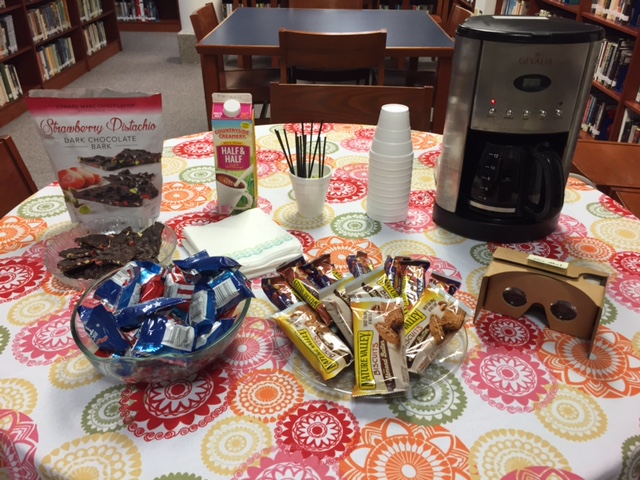
When I came back to school at the end of August, I was excited to share the things that I learned while at the Google headquarters. Through a series of fortunate events, a number of teachers and administrators came to visit the library early on in the year and had the opportunity to test out the Google Cardboard that I received while at Google. It probably helped that I lured them in with chocolate, caffeine, and the promise of a virtual beach vacation (if only for a few moments!). I was fortunate to receive 35 VR viewers through funds received as part of a STEM grant (thank you, Mr. Kotch!), and I was able to put them right to good use.

Through collaboration with several Spanish teachers, I have been taking our students on virtual field trips for a few years; however, our students had never been on a trip like this one before! In an informal poll, I discovered that none of our approximately 120 Spanish III students had ever used a VR viewer before, so this was a pretty unique and exciting experience for them.

We started our trip with what was formerly called the Google Cultural Institute, now labeled Google Arts and Culture. I like students to explore locations curated for their cultural significance. Then, students learned how to use the VR viewers with Google Street View and Google Cardboard apps. They were asked to download these free apps to their smartphones ahead of time, if permitted. Not every student could download the apps, which we had anticipated, so students were able to share or use the few iPhone/iPod devices that we brought with us. And this was the result:


Both the Spanish teacher and I received overwhelmingly positive feedback from students on their experiences with their virtual field trip. In the past, students seemed to learn something from the VFT activity, but we had never received such enthusiasm before use of the VR viewers.

One of my biggest goals as a school librarian is to provide cultural experiences whenever possible. Part of our district's mission statement requires that we grow students into "productive and responsible citizens of an ever-changing global society." I hope that the tiny taste of the world that I can provide for our students might inspire them to explore further in real life.

If you would like to modify my lesson materials for your classes, they are accessible here.


Creative Commons License
Virtual Spanish Trip by Katherine Kauffman Roth is licensed under a Creative Commons Attribution 4.0 International License.


Update: Below is some student feedback from the lesson.

Sunday, February 21, 2016

The Library is a Good Place: Small Successes Keep Us Going

"The library is a good place," one of my students said this morning as she sat at the circulation desk and took in her surroundings. I tried to see the space as she saw it in that moment: a group of girls furiously finishing geometry homework tucked away in the fiction section...friends sitting in cushy blue chairs sharing a pair of headphones...a freshman boy flashing an appreciative smile as he takes a Hershey Kiss from the candy dish next to the sign-in sheet. "I cannot believe I didn't know about this place before last year, Ms. Kauffman. It's a good place," she concluded.

She put into words exactly how I want students to view this space: as a positive haven in their busy lives. In the same breath, she also expressed the biggest problem: many students are unaware that the library exists. All students attend a Freshman library orientation, but somewhere in-between their regimented Freshman year and their less-structured years after that, they seem to forget (or worse yet, not realize) what the library can offer them.

This year, we seem to be starting to hit our stride. I would still like to work on promoting the library to those that aren't aware of what it can offer, but we have at least experienced an increase in readership, which is encouraging. I always feel most fulfilled in my career when I get to support our students, especially those unlikely readers. I had a tall, slender senior walk in the other day with a sideways black cap (totally against dress code), saggy jeans, and a plaid flannel shirt. I recognized him as one of the students taking a remedial writing course because he spent a lot of time during class typing (or not typing) his paper in the library. He asked for some read-alike suggestions. I hadn't read the book he mentioned and, based on the cover, had the misconception that it was about overcoming addiction. After doing some research, I discovered that it was really more about coping with mental illness and depression. So, I suggested Ned Vizinni's It's Kind of a Funny Story and Stephen Chbosky's The Perks of Being a Wallflower - both favorites for addressing difficult topics with a touch of humor. He came back the next day specifically to tell me how much he loves Vizinni's story. After having a stressful day when nothing seemed to be going right, his comment made my whole week. This just goes to show that a kind gesture can be the fuel to keep someone doing what they are doing right.

This student taught me a lesson, and I will continue to more often let others know when they have made a difference in my day, my week, my life. Perhaps this is one small way that I can continue to make the library a "good place" for all who use it.

Thursday, December 17, 2015

Highlights from AASL 2015

 Beautiful Columbus, OH! There could not have been a better city to host the conference. I had a lovely dinner in German Village after spending the first day learning at the Idea Lab.

 I met up with another Westmoreland County librarian! I was excited to see so many LMS's from Western PA.

"Beyond Issue" books panel really gave me the opportunity to think about the difference between books about mental illness and books with dynamic characters who happen to experience mental illness. Great book list!

 I attended another fantastic panel that featured "perspectives from the Middle East." The moderator was none other than Sabaa Tahir! So star-struck.

Brian Sleznick's keynote was so fantastic that it prompted me to unexpectedly purchase The Marvels and get it autographed! He is a born storyteller. I put his keynote right up there with the Neil Gaiman lecture I attended in Pittsburgh.

Thursday, November 12, 2015

NEA Foundation Learning and Leadership Grant and the 2015 PaLA Conference

I am very fortunate to be one of the 2015-2016 recipients of the NEA Foundation Learning and Leadership Grant. This grant provides teachers the opportunity to participate in professional development activities that they otherwise would not have had the means to fund themselves. Considering the state of Pennsylvania is now five months without a budget, schools are cutting "non-essentials," like PD. As a school librarian, my job entails collaborating with teachers, librarians, administrators and other professionals. Thus, I consider learning about new educational technology, new books, and new teaching methods or project ideas to be an essential part of my job. Collaboration is ultimately the reason I decided to seek out alternative means of funding conferences this year, and it is the theme for the PD I have selected to fund with this grant.

My first order of business was to attend the Pennsylvania Library Association conference in State College, PA. I have never attended this conference before. While at PaLA, I was able to meet librarians in all fields of librarianship, including public, outreach, academic, research, special, and more, all from towns throughout the commonwealth. I leaned from my colleagues that despite our different library fields, we face so many of the same issues: waning budgets, the need for diverse materials, changing patron interests, new technology and more. I also discovered that our differences can be mutually beneficial. Public libraries offer students a place to research, read, and use the internet when the school library is closed. They can offer special teen programs after the school day is over. Academic libraries provide research materials that students can borrow and special archived collections that a school library would not have room to carry. And of course school libraries offer teens instruction on how to properly use library materials in school and afterwards.

In terms of sessions, by far I was most excited about the "We Need Diverse Books" YA authors
panel. I was introduced to a number of PA authors who feature diversity in their stories, even if diversity is not the focal point. The authors stressed that diverse books have so much to offer teens beyond being a reflection of a reader's own diversity. Librarians should seek out diverse books because they are good stories, and they can perhaps encourage teens to see a world beyond their own. I will be able to incorporate these stories into a fiction project I collaborate on with one of our language arts teachers.

Additionally, I attended the PA Forward Cream of the Crop session. PA Forward is an initiative that brings librarians together to promote the five literacies. Librarians had just a few minutes to share an exemplary program or resource that they use to address basic, information, civic, financial or health literacy. Some of the ideas that I found most interesting and relevant included a volunteer fair, grant tips to acquire maker materials, and a photo station in the library. I could see setting up a selfie station in the library before winter break with a green screen app. From ideas I gathered at this session and others at the conference, I am also tossing around the idea of holding a college application-writing session one evening. If I were to create a volunteer fair of college-application session, I would need to collaborate with administrators, counselors, teachers, community members, and college personnel.

Finally, one of the evening activities was entitled "Paint Space." During this session, participants watched YouTube videos on how to paint tree branches. Then, we had the chance to recreate the tree branches on our own canvases. This was a fun and also an easy-to-recreate maker activity. As my library is in desperate need of a makeover, I have already purchased art supplies for students to paint pictures for our walls. Although I am not an artist, YouTube instructors take some of the pressure off of the librarian! I cannot wait to update our artwork! Although this would not be so much of a collaborative lesson for me, maker activities are often inherently collaborative for students. I may also request the help of the Art Club sponsor to spread the word that her members could leave their mark on the library - quite literally!
Overall, this was a fantastic conference, and I was happy to see other sides of my profession.

Thursday, October 15, 2015

Library Promotion

As I prepare for my session on collaboration for the AASL 2015 National Conference, I can't help
but reflect on my journey through library promotion. The two facets of school librarianship certainly go hand-in-hand. When I accepted a position as a part-time middle school librarian/part-time high school English teacher back in 2011, I didn't know much about library promotion. In fact, promotion is one of the biggest facets of the job that sets a teacher librarian (with a flexible schedule) apart from a classroom teacher. I knew I needed to make teachers and administrators aware of what the library had to offer them, but I wasn't quite sure how to go about doing that effectively. And I probably didn't do a great job that first year. I had a lot of obstacles to overcome both personally and professionally, but those cannot be excuses for scanty library use. I only really started to become adept at library promotion after I joined the Pennsylvania School Librarians Association Promotions Committee - and I joined quite by accident! I attended my first leadership summit expecting to be a part of another committee that needed more members, but unfortunately the only other member from this committee had other obligations during our meeting time. So, in an effort to make my trip to the workshop worthwhile, I sat down with a lively and organized group of ladies (imagine that - organized librarians!). This group turned out to be the Promotions Committee, and they welcomed me with open arms. Not only did we discuss different ways of effectively promoting our services to our school communities, but we also created a number of advocacy lists to help other librarians discover great ways of promoting their libraries.

One of the greatest professional experiences I have had was presenting a session at the PSLA annual conference. Along with four other amazing school librarians who work with students ranging from grades K-12, we presented ideas for library promotion. While presenting was fun, the best part of doing this presentation was learning from all of the other fantastic librarians who attended the session.  The greatest take-away was that a conference session presenter is merely a facilitator, and using the time to have a group brainstorm can be immensely beneficial to all participants.

Since this presentation, I have now implemented several promotional ideas that I gathered from session participants. One that I have used the past two years is the Used Book Sale. Not only am I able to make a little bit of petty cash for other promotions, but also I am able to provide a reason for parents to check out the library during open house, an incentive for administrators to come see what we are up to in the library, and maybe a way to coax a few students and teachers who do not normally frequent the library to see what we have to offer them. We have received book donations from community members who are happy to give their used books a meaningful home, and we have been able to fund prize drawings and reading incentives for other library promotions.

Based on my previous experiences with library conferences, I cannot wait to facilitate a discussion on collaboration at AASL 2015. I cannot even anticipate the kinds of strategies and project ideas I will gain from my colleagues who have school libraries all over the nation. But I know that I will return from the conference excited to try new ideas and ready to collaborate with teachers.

Wednesday, July 8, 2015

PA School Librarian in Germany: Private Schools

On Monday we visited a private all girl's Catholic school. The school was founded 250 years ago, and at one time was run by nuns. This school offers both a gymnasium and a vo-tech education.

Although the school is a private school, they still receive funding from the state, and therefore is free for students to attend. Students do not have to be Catholic, or even Christian, to attend the school; however, they must have a very moral foundation. Likewise, teachers do not have to practice a particular religion, but they seem to be held to a high moral standard (not unlike teachers in the US). The school is founded on the ideas of respect, help, solidarity and a commitment to making the world a better place. In the 11th-grade, students must complete a 4-week internship at a social institution. Many students intern at hospitals or kindergartens in order to fulfill this work requirement.

God, of course, is important at this Catholic school. Students must periodically attend services at school, but these services do not occur weekly. Students do not necessarily attend church with their families every weekend, and membership in a church is not compulsory.

The sciences are a big focus of the school, and because of this focus, girls tend to perform well on their science exams. Music is also a big focus, and the school boasts two orchestras: one for the younger grades and one for the older. Students have the opportunity to perform at the beautiful concert hall in Mainz.

Many exchanges are offered with foreign schools, and students are required to learn English or French as the first foreign language, and Latin or Spanish as the second foreign language. Eighty percent of girls attending the gymnasium end up also attending university.

At the vo-tech program, girls have the chance to study economy and administration or home economics and nutrition. Students receive the Realschule certification from this program, and the school does accept students from other schools for just the two year vo-tech program.  After the vo-tech program is over, students can continue attending a specialist school in their field, or else they can choose to continue school and receive their Abitur.

We had the chance to speak with some fantastic English teachers who very generously gave of their time. The woman I spoke with had actually attended the school as a girl and then quite by coincidence was assigned to teach at this school by the state. She mentioned that she is thankful for this placement, and I must say that the teachers at the school all seemed very positive and they seemed to like their school and their colleagues very much. What a wonderful place for girls to be educated!

PA School Librarian in Germany: Cultural Experiences

On Saturday of the Fulbright program in Germany, we had the day off. By "day off" I mean that we had an opportunity to create our own cultural experience. I chose to visit Heidelberg, which is only 50 minutes away from Mainz by IC train. I think pictures will do the trip better justice than any words could ever do!


In the evening, one of our group members organized a beautiful trip to Bingen, which is about a 30 minute train ride from Mainz. Bingen and the surrounding towns were having a summer celebration. Each town provided a fireworks display, and boats would follow the fireworks on the river. It was quite a sight!

Sunday, July 5, 2015

PA School Librarian in Germany: Gymnasium


I think that a lot of us were very much looking forward to observing a gymnasium. This school could be compared to an elite secondary school in the States. Serving grades 5-12 (formerly through grade 13), every student and teacher is required to learn English starting at grade 5 (if not earlier), and in the upper grades students must also choose to learn one of the following: French, Spanish, Latin or Italian. All students experience a bilingual education, meaning that they not only learn 2 additional languages, they also have classes taught in English or French. For example, a student might take economics or chemistry, but several days a week they learn the subject in a second language. This is a very authentic way to learn another language, and it appeared to be very effective in creating bilingual students.

The majority of students at the Gymnasium level must attend their local school. This particular school, however, has an excellent gifted program and can accept students from other states just for this specialized program. Grades are determined as 1 (equivalent to approximately an A) through 6 (failing).


In year 10, students receive a 2-week work placement in Germany, England or France. Students here often become so proficient in French that they will take the French exit exam in addition to the Abitur; this ensures that they can seamlessly attend post-secondary education in France, if they desire to do so. The Abitur counts for 1/3 of the graduation score, and the state of Rhineland-Palatinate is the only one of the 16 states to offer un-centralized graduation tests. Teachers create several tests to be sent to the Ministry of Education, the Ministry chooses the test to be administered, and the teacher receives the assessment right before they must administer it to students.


A typical schedule is structured like this: Monday-Thursday classes run 7:55-4:05 and Friday 7:55-12:55. Most lessons are in the morning before lunch, with sports, art and clubs taking place in the afternoon. Most homework is completed during the school day when students have study or tutoring breaks. This school also follows the MINT program, which stands for math, ICT, science and technology, which sounds much like the trend for STEM education in the US. Students also must choose three areas of focus, almost like majors, in order to complete their program of study.

Several of us had the chance to observe a religion class during which a student presented information on Chagall. Mainz is home to a chapel with Chagall glass windows adorning each wall, and so students will visit the chapel next week to see the work in person. Students analyzed the work projected onto a screen using the stylistic and biographical information provided by the presenter. At the end of the presentation, the teacher asked students to offer an evaluation of the presenter, and students very professionally offered both praise and criticism.


The students we spoke with were very impressive. It was clear that these students were very bright and had experienced an excellent education. Their English proficiency was impeccable, and each of them had spent a significant amount of time in the US. All three of them were serious students, but with different majors of study and interests outside of school. All of them plan to attend Universitat after Gymnasium, although only one of them seemed to know where she would like to attend after school.


This school was also the first public school we visited that offered a traditional school library for students. The book cataloging and management of the library is performed by parent volunteers. The mother running the desk during my visit very kindly answered all of my questions about school libraries in Rhineland-Palatinate. She had been helping with the school libraries since her children were young (their primary school had a library, as well). Libraries are traditionally run by mothers in two-hour shifts. This one had 11 computers for students to use in order to create projects or type papers. There were volumes of popular fiction and materials for research. The mother running the library confirmed what student had mentioned to me; teens seem to prefer to buy their books rather than borrow them from the school library. I do not know if this is typical of German teens in general, or just of the teens in the schools we visited.

Overall, it was a fantastic visit, and I especially enjoyed speaking with the panel of German students.

Sunday, June 28, 2015

PA School Librarian in Germany


Photo taken from Mt. Washington
I am currently in the air, having just left Pittsburgh International Airport bound for Mainz, Germany*! I have been anxiously anticipating this moment since February, after learning that I was accepted by the German American Fulbright Commission to attend a seminar for high school teachers. For the next two weeks, I will participate in a program entitled “Education in Germany - a Multi-Faceted System,” along with 14 other American teachers. Although the program schedule is very full, I find it important to document my experiences here, whenever I have a free moment. I hope to be able to look back on these two weeks and continue to learn from them, long after the program is over.


Mainz-bound!
“As a school librarian,” I state in my seminar application, “I convey my curiosity and passion for learning through the way I approach my profession and through the way I live my life. This passion for learning continually manifests itself as a desire to be culturally literate for my students, for my peers, and for myself.” I feel incredibly lucky to have the opportunity to learn about the German education system from the teachers at German schools and through the faculty at Johannes Gutenberg University, Mainz. I will be forever grateful to these teachers (and to the German American Fulbright Commission!) for helping me to gain a greater sense of cultural literacy. In turn, I hope to be a good ambassador for my school, the library profession, and my country.

*I wrote this entry in the air, but had to post it when I had access to wifi. So, (update) I have arrived!
** For those interested in joining a similar program (either as a professional in the US traveling to Germany or as a professional in Germany traveling to the US), see the German American Fulbright Commission website. 
On the Main River in Frankfurt