Showing posts with label student-centered. Show all posts

Thursday, January 19, 2017

Perseverance in the Library

At the beginning of November, I received the call that I have feared every year since I started my school library career: as of that moment, library funding was completely cut. To be fair, all "non-emergency" funding was cut in the entire district. According to the new algorithm for determining federal funding, my district would be receiving significantly less than expected. This "moratorium on spending" of course trickled down to each professional in each building. In some ways, I was fortunate that I got the call in November instead of July because I had already purchased a few staples like our online databases and our reading team books. But I was expecting to spend approximately 70% of the library budget sometime before February, which is our usual yearly spending cutoff date. I took a little bit of time beating myself up for not focusing more on purchasing at the beginning of the school year, but there was no point in brooding over something that I had no control over. Instead, I listed my major goals for the year to determine exactly what I needed in order to continue having a successful year for the library. The first goal was to purchase a list of 50 books that were primarily student recommendations. Contrary to popular opinion, fiction reading in my school library has increased this year, and I am absolutely determined to continue this trend. Secondly, a student last year took the initiative to start a student-run book club during lunches after the reading competition concluded in the Spring. They had selected two books, and we would need at least 25 copies of each. Finally, we need funds to attend our annual field trip to the county reading competition. I needed a plan.

First, I recalled our local Barnes and Noble store contacting me in the past about facilitating an in-store book fair. I contacted them again, and set up a meeting with the manager to discuss all of the details and to set up the date. We chose a date approximately two weeks before Christmas, which proved to be an effective time to have the fair. We advertised in school, on social media, and to parents and community members. We also brought copies of our donation code with us in case people in the store asked us who we were (we were all wearing our school colors or our reading team t-shirts). With a combination of luck and hard work, we earned over $1,600 in books for our library. I am incredibly thankful to Barnes and Noble for helping us to fill our library with new books, and I feel so lucky to work with such wonderful and motivated students. We had students who offered to stay at Barnes and Noble all day to give our donation code to parents and community members who asked for it, although we had such a great volunteer response that we only needed students to stay for 1-2 hour shifts. It was such a great, uplifting day!

Secondly, to ensure that we had enough funds to purchase books for our student-run book club and to possibly go on a field trip, I wrote several grants. For one grant, I was interviewed at the YALSA Symposium in Pittsburgh. My grant proposal was unfortunately not accepted, although the process was a positive one. For this grant, we were required to be able to speak on how individual conference sessions inspired our grant idea and how we might use what we learned in order to improve our home library. Although my grant idea was not selected, I am still hoping to be able to gain funds at some point to make my idea a reality.

Finally, Wal-Mart came through and granted us $750 to run our student book club this year! I am extremely thankful to our local Wal-Mart store for selecting our proposal. I recommend that other school libraries in need consider looking into grants offered by large and small organizations alike. Many companies are happy to support public education, and this librarian is incredibly thankful to them.


Friday, October 7, 2016

Virtual Field Trips

In the summer of 2016, I was very fortunate to attend the Google Geo Teachers Institute in Mountain View California. I actually took a brief break from driving down the CA coast for my honeymoon (shout out to my new hubby for hanging out in Palo Alto while I was at Google!) in order to attend. And the side trip to Google headquarters was well worth it. I was especially excited to meet British educator, explorer and photographer, Jamie Buchanan-Dunlo of Digital Explorer. Among other impressive pursuits, his work is used by Google Expeditions to create meaningful virtual field trips for students. A long-time tech hero of mine, Jerome Berg, also spoke and presented a session on his project Google Lit. Trips. As a former English teacher, Berg's ideas influenced the way that I approached literature then, and continue to inspire my approach to literature now.

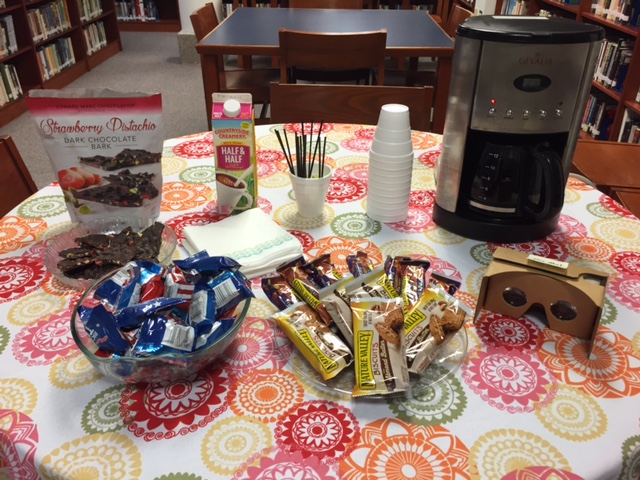
When I came back to school at the end of August, I was excited to share the things that I learned while at the Google headquarters. Through a series of fortunate events, a number of teachers and administrators came to visit the library early on in the year and had the opportunity to test out the Google Cardboard that I received while at Google. It probably helped that I lured them in with chocolate, caffeine, and the promise of a virtual beach vacation (if only for a few moments!). I was fortunate to receive 35 VR viewers through funds received as part of a STEM grant (thank you, Mr. Kotch!), and I was able to put them right to good use.

Through collaboration with several Spanish teachers, I have been taking our students on virtual field trips for a few years; however, our students had never been on a trip like this one before! In an informal poll, I discovered that none of our approximately 120 Spanish III students had ever used a VR viewer before, so this was a pretty unique and exciting experience for them.

We started our trip with what was formerly called the Google Cultural Institute, now labeled Google Arts and Culture. I like students to explore locations curated for their cultural significance. Then, students learned how to use the VR viewers with Google Street View and Google Cardboard apps. They were asked to download these free apps to their smartphones ahead of time, if permitted. Not every student could download the apps, which we had anticipated, so students were able to share or use the few iPhone/iPod devices that we brought with us. And this was the result:


Both the Spanish teacher and I received overwhelmingly positive feedback from students on their experiences with their virtual field trip. In the past, students seemed to learn something from the VFT activity, but we had never received such enthusiasm before use of the VR viewers.

One of my biggest goals as a school librarian is to provide cultural experiences whenever possible. Part of our district's mission statement requires that we grow students into "productive and responsible citizens of an ever-changing global society." I hope that the tiny taste of the world that I can provide for our students might inspire them to explore further in real life.

If you would like to modify my lesson materials for your classes, they are accessible here.


Creative Commons License
Virtual Spanish Trip by Katherine Kauffman Roth is licensed under a Creative Commons Attribution 4.0 International License.


Update: Below is some student feedback from the lesson.

Sunday, July 12, 2015

PA School Librarian in Germany: Gesamtschule

Gesamtschule with beach volleyball court
On Wednesday, we visited a beautiful Gesamtschule, which is a comprehensive school. Gesamtschulen take elements from all three tracks of schooling available in most German states and provides them all within one school. The idea for comprehensive schooling arose in the 1960s out of a social need to have more flexible movement of students between German schooling tracks. This type of schooling is arguably the closest to the American schooling system.

The school is broken up into grades 5-10 and 11-13. Students who stay through grades 12 or 13 are studying to take the Abitur and then will be admitted into university. The benefit of attending a Gesamtschule is that students do not have to decide which track to pursue until after grade 6, whereas students in the traditional system decide after grade 4.

Pun using "Abi" (Abitur) and Harry Potter!
The particular school that we visited is 30 years old, it was the first comprehensive school in
Rhineland-Palatinate, and it is also one of the largest comprehensive schools in the state. The school has approximately 130 teachers, 2 librarians, a social worker and over 2,000 students. Most notably, the school offers 192 activities. Unlike American schools, all subjects considered to be non-academic are held in the afternoon, and these do not have to be lead by a teacher. These activities include art, music and sports, just as examples. This school is considered to be an elite soccer school, and therefor there is a big focus on athletics.

In addition to having a number of athletic facilities, the school displays student artwork on nearly every wall. As visitors, we could tell that the school community takes a lot of pride in the work of their students, which was really wonderful to see.

After receiving an overview of comprehensive schooling in Germany, we broke off into groups to visit classrooms. Many classes were winding down at the end of the school year, but we did have the chance to see an English class preparing to watch the movie Dead Poet's Society. Students prepared character sketches by performing freeze frames and composing short fiction pieces. The performances were entertaining and demonstrated that students not only understood the language they had to use during their group planning time, but also that students were adept at analysis and characterization.

During our lunch at the school, several grade 5 students approached us, giggling, wanting to test out their English language skills. I was impressed at their confidence, curiosity and desire to learn even in unstructured settings. I have been very reserved in testing out the little German that I have picked up prior to and during this trip; I think I could take a cue from these tenacious students!

Sunday, July 5, 2015

PA School Librarian in Germany: Technical Schools

We attended two fantastically organized vocational school visits today. The first visit was to a school that offers theoretical and practical training to students 16 years of age and older. These students could attend this school from any of the secondary schools offered in Rhineland-Palatinate. The school is home to 3715 students in 187 classes with 165 teachers. Students typically attend the school for 2-3.5 years and can receive a number of certificates upon completion. Most students take on an apprenticeship, and a number of the co-operative programs are international. The school specializes in economics, health/social care, and technology. After an introduction to vocational education and certification in Rhineland-Palatinate and Germany in general, we broke up into groups of 2-4 teachers and a student took us around to two different classroom observations. The first observation for my group was of an English class, and the second was of a network programming class. The instructor in the last classroom asked a student to speak with us about the coursework the students were doing, but we found that many of the students spoke English very proficiently and were very open and willing to speak with us. Two students we spoke to had successfully completed the Abitur, but then decided to attend technical training even after working through several years at University. One student explained to us that even though each student had taken a different route to get to this program, that he did not think better or less of any of them. The students also confirmed that although IT work pays very well in the US, it does not pay nearly as well Germany.

The candid conversations we experienced here with both staff and students has been unparalleled thus far. The school was very welcoming and had clearly made a lot of preparations in order to make our visit interesting, informative, and enjoyable. Of course our favorite part of the program was the homemade meal that was prepared, in part, by students at the school. The creamy cucumber soup was one of the best things I have tasted in Germany! And the homemade ice cream, prepared with raspberries from the chef's garden, was just "fantastisch!" Not even pictures will do this meal justice, but here they are anyway!

After our visit to the technical school, we attended a tour and talk at a school that students attend in conjunction with their internship. The school is run more like a corporation, as companies can own shares of the co-operative, while others are considered customers. Either way, companies, trainees and professional instructors all seem very invested in the practical programs available at this school. Instead of each company training their interns individually, customers can send their trainees here. The advantages of this system are varied, but one of the best reasons to run trainings like this is that company machines are then not taken up by interns. Instead, machines available at companies can be used for production. The school offers training for 300 professions, and they serve both young students and employees needing updated training in their fields. Additionally, the school has a partnership with a university in Bingen and can now offer a BA in engineering. Most importantly, the school feels trainees must gain social, specialized and methodical skills before leaving the program. The new director of the school was very clear that social and communication skills are incredibly important in industry, and they cultivate these skills in their students. This school, while very well funded by corporations, amazingly is still a part of the public school system.

Thursday, July 2, 2015

PA School Librarian in Germany: Realschule

"Hello, USA!" a student enthusiastically greets me as I entered a local realschule plus here in Mainz. This school is comprised of two buildings: one for grads 5-6 and another for grades 7-10. Much like the grundschule we visited the day before, this middle-level school is comprised of a large immigrant population. The school houses 850 students, many from Turkey and Africa, along with 80-90 teachers. For all students at this level, learning English is compulsory. This particular school has been bestowed the honor of being considered a Europaschule, which translates to "European School." According to Wikipedia (I know it is a librarian sin to use Wikipedia, but it had the best translation!), a Europaschule must follow several criteria: "1. Integration of European issues, 2. Language Learning, 3. Project-oriented school partnerships and internships, 4. Personnel training and development, 5. European School in the Region, 6. Quality Assurance" ("Transnational Criteria"). As part of these criteria, students have an option to receive a three-week work experience in England. 

At this school, a head teacher or principal along with his deputy gave us an understanding of how their school works, but also how secondary education in general is run in the state of Rhineland-Palatinate. In Germany as a whole, the head of the school (what we would call a principal), must also teach classes - minimum four per week. Teachers and students must attend school for 192 days a year, and teachers receive six days of leave for self-chosen, compulsory trainings. Periodically, principals may need to ask teachers to complete paperwork over student breaks, but teachers are guaranteed at least 30 days of leave time.


Included in the school's mission statement are three basic rules: punctuality, respect, and order. I observed these rules in the English classroom I had the pleasure of observing. The deputy principal invited half of our American group into his classroom, while the other half observed another English class. The teacher very kindly incorporated us into his lesson. We each introduced ourselves, along with our state of origin, and the students answered some questions in English about America. Then, we were asked to wander around the classroom and help students to complete a summary of a Mark Twain story they read for class. We were thankful to have the opportunity to work with students, and we were also grateful for the lovely lunch the school provided for us!


"Transnational Criteria." Bundez-Netzwerk Europaschule. 2015. Web. 2 July 2015. <http://translate.google.de/translate?hl=en&sl=de&u=https://de.wikipedia.org/wiki/Europaschule&prev=search>.

Friday, February 20, 2015

Girl's Mentoring Event

We have some pretty fantastic kids at school - kids who not only work hard, but also students who look out for one another. A group of incredible senior girls decided to start a girl's mentoring program called the Knights in Shining Armor. This organization brings together friendly, motivated, successful senior and freshman girls who want to get involved in their school. Together, they do a variety of activities: yoga, crafts, book clubs, etc., lead by different teachers throughout the school. During these activities, the freshmen can ask for advice from their older, wiser peers, or just network with one another and make new friends.
"Knitted Heart." by mararie is licensed under CC BY 2.0

Just before Valentine's Day, I offered to facilitate a craft afternoon where students could make cards or little candy boxes. I provided hot chocolate with heart marshmallows, and the girls brought brownies and popcorn to snack on during the craft hour. Listening to these smart, funny, strong, and friendly girls work together and offer their expertise on all things school made my heart happy. I didn't know many of the girls before the event, but I left with a smile on my face that there are such wonderful things going on at our school - events that are entirely student organized and student driven. These girls recognized a need for a mentoring group that could lead their younger peers on the right path to success, so they made one. And I know I am not alone in my pride for these lovely young women, as a number of teachers wanted to know what they could do to contribute to such a fantastic organization. I think I certainly learned an important lesson from them: do not wait for good things to happen, make them happen!