Showing posts with label Google Geo Teachers Institute. Show all posts

Wednesday, June 28, 2017

Google Earth and National Geographic Society: One Educator's Story

At Metsker Maps in Seattle
One of my fondest memories as a kid growing up in central Pennsylvania was frequenting the Penn State Creamery with my family. My parents would patiently wait while my little brother and I would mull over flavors like Peachy Paterno and WPSU Coffee Break in order to choose the perfect scoop. While we licked our cones trying to chase each drip before it reached our sleeves, we would flip through National Geographic magazines piled high on each outdoor table by a local collector. I remember staring at the iconic yellow borders and marveling at the photos inside depicting the splendor of our National Parks or the seemingly fantastical traditions of people from far away lands.

So when I was offered an opportunity as an adult to attend a workshop in Seattle, WA hosted by National Geographic Society and Google Earth, I felt nostalgia mixed with excitement. While I was expecting to be wowed by some amazing tech, I had not expected to be in the presence of such skillful, inspirational, and worldly educators. A number of very mindful teachers there follow the UN Global Goals, which strive to end poverty and inequality, and to make a dent in climate change.
@ Google Headquarters in Seattle
As I click through the stunning photographs depicted in the Pristine Seas Voyager Story, I can't help but marvel at how this new platform has transformed National Geographic. And yet, I am reminded of the wonder I felt as a little girl flipping through glossy pages outside of the Creamery. Because whether the platform is print or digital or video matters little, as long as it inspires the next generation to care about conservation and cultural literacy. So thank you Google Earth and National Geographic Society for an absolutely unforgettable experience. But more importantly, thank you for continuing and updating the 130 year legacy that National Geographic Society has established for inspiring kids to care about making the world a better place.

Prior to attending the Hackathon, we were asked to participate in Phase I of the National Geographic Educator Certification program. During the webinar, we learned about Nat Geo's philosophy on teaching and learning, which includes "how the human and natural worlds work at local, regional, and global scales." Meaningful units can start with a question, then students collect data to begin formulating an answer to the question. Students continue by bringing data sets together using a visual tool, such as a digital map, before creating a product to share with their teacher and classmates and perhaps even parents or community members. Finally, and this is the piece that pushes a lesson beyond school into the realm of meaningful learning, students must act to bring about change. A number of educators present at the Hackathon shared how they are already doing this in their schools or classrooms, breaking down each step and aligning each piece with the UN Global Goals.

Googlers shared with us the Google Geo tools that are now available to make the stories we want our students to hear, and ultimately the ones we hope they can tell, incredibly compelling. Just this past Monday at ISTE, the Google Earth team rolled out the Google Earth Education Program, which features Voyager Stories. Under the Education tab, a number of these stories were created in conjunction with National Geographic Society and their explorers. These stories are tied together with Idea Sets (including discussion questions, activities, videos, and more) for teachers on the National Geographic Society Education site. Now teachers have a wide array of meaningful lesson activities to choose from when carefully crafting engaging units for their students. We don't have to start from scratch! Many lesson activities are guided by Nat Geo explorers, they outline problems, and most importantly they provide students with opportunities to propose solutions.


Check out a brief tutorial below:

Sunday, March 26, 2017

Blog Post for PBS Teachers' Lounge

I was thrilled to contribute a blog post for PBS Teachers' Lounge, published on March 24, 2017. It was based off of a PA School Librarian post entitled "Virtual Field Trips," but it goes into much more step-by-step detail as to how a beginner can create a successful virtual field trip for their students. Here's the post: http://www.pbs.org/education/blog/foreign-language-virtual-field-trips-a-travel-guide-for-beginners. After creating the post, I learned about a PBS virtual field trip that students could take using 360 degree video content from their Civil War series Mercy Street. The brief video is available from the free Littlstar app, and the lesson can be extended to include a discussion and a written activity or assessment. I had the opportunity to forge a new collaboration with one of my social studies colleagues, so this is why I am so thrilled to learn about new and engaging PBS virtual reality content. Hopefully a post on this lesson soon!

Friday, October 7, 2016

Virtual Field Trips

In the summer of 2016, I was very fortunate to attend the Google Geo Teachers Institute in Mountain View California. I actually took a brief break from driving down the CA coast for my honeymoon (shout out to my new hubby for hanging out in Palo Alto while I was at Google!) in order to attend. And the side trip to Google headquarters was well worth it. I was especially excited to meet British educator, explorer and photographer, Jamie Buchanan-Dunlo of Digital Explorer. Among other impressive pursuits, his work is used by Google Expeditions to create meaningful virtual field trips for students. A long-time tech hero of mine, Jerome Berg, also spoke and presented a session on his project Google Lit. Trips. As a former English teacher, Berg's ideas influenced the way that I approached literature then, and continue to inspire my approach to literature now.

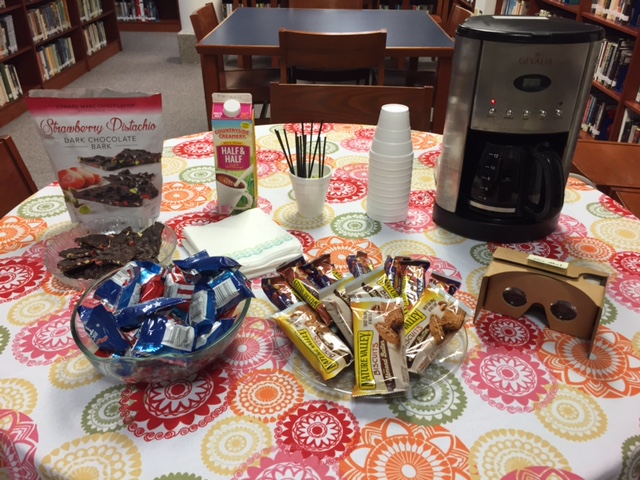
When I came back to school at the end of August, I was excited to share the things that I learned while at the Google headquarters. Through a series of fortunate events, a number of teachers and administrators came to visit the library early on in the year and had the opportunity to test out the Google Cardboard that I received while at Google. It probably helped that I lured them in with chocolate, caffeine, and the promise of a virtual beach vacation (if only for a few moments!). I was fortunate to receive 35 VR viewers through funds received as part of a STEM grant (thank you, Mr. Kotch!), and I was able to put them right to good use.

Through collaboration with several Spanish teachers, I have been taking our students on virtual field trips for a few years; however, our students had never been on a trip like this one before! In an informal poll, I discovered that none of our approximately 120 Spanish III students had ever used a VR viewer before, so this was a pretty unique and exciting experience for them.

We started our trip with what was formerly called the Google Cultural Institute, now labeled Google Arts and Culture. I like students to explore locations curated for their cultural significance. Then, students learned how to use the VR viewers with Google Street View and Google Cardboard apps. They were asked to download these free apps to their smartphones ahead of time, if permitted. Not every student could download the apps, which we had anticipated, so students were able to share or use the few iPhone/iPod devices that we brought with us. And this was the result:


Both the Spanish teacher and I received overwhelmingly positive feedback from students on their experiences with their virtual field trip. In the past, students seemed to learn something from the VFT activity, but we had never received such enthusiasm before use of the VR viewers.

One of my biggest goals as a school librarian is to provide cultural experiences whenever possible. Part of our district's mission statement requires that we grow students into "productive and responsible citizens of an ever-changing global society." I hope that the tiny taste of the world that I can provide for our students might inspire them to explore further in real life.

If you would like to modify my lesson materials for your classes, they are accessible here.


Creative Commons License
Virtual Spanish Trip by Katherine Kauffman Roth is licensed under a Creative Commons Attribution 4.0 International License.


Update: Below is some student feedback from the lesson.