Showing posts with label teacher librarian. Show all posts

Wednesday, June 28, 2017

Google Earth and National Geographic Society: One Educator's Story

At Metsker Maps in Seattle
One of my fondest memories as a kid growing up in central Pennsylvania was frequenting the Penn State Creamery with my family. My parents would patiently wait while my little brother and I would mull over flavors like Peachy Paterno and WPSU Coffee Break in order to choose the perfect scoop. While we licked our cones trying to chase each drip before it reached our sleeves, we would flip through National Geographic magazines piled high on each outdoor table by a local collector. I remember staring at the iconic yellow borders and marveling at the photos inside depicting the splendor of our National Parks or the seemingly fantastical traditions of people from far away lands.

So when I was offered an opportunity as an adult to attend a workshop in Seattle, WA hosted by National Geographic Society and Google Earth, I felt nostalgia mixed with excitement. While I was expecting to be wowed by some amazing tech, I had not expected to be in the presence of such skillful, inspirational, and worldly educators. A number of very mindful teachers there follow the UN Global Goals, which strive to end poverty and inequality, and to make a dent in climate change.
@ Google Headquarters in Seattle
As I click through the stunning photographs depicted in the Pristine Seas Voyager Story, I can't help but marvel at how this new platform has transformed National Geographic. And yet, I am reminded of the wonder I felt as a little girl flipping through glossy pages outside of the Creamery. Because whether the platform is print or digital or video matters little, as long as it inspires the next generation to care about conservation and cultural literacy. So thank you Google Earth and National Geographic Society for an absolutely unforgettable experience. But more importantly, thank you for continuing and updating the 130 year legacy that National Geographic Society has established for inspiring kids to care about making the world a better place.

Prior to attending the Hackathon, we were asked to participate in Phase I of the National Geographic Educator Certification program. During the webinar, we learned about Nat Geo's philosophy on teaching and learning, which includes "how the human and natural worlds work at local, regional, and global scales." Meaningful units can start with a question, then students collect data to begin formulating an answer to the question. Students continue by bringing data sets together using a visual tool, such as a digital map, before creating a product to share with their teacher and classmates and perhaps even parents or community members. Finally, and this is the piece that pushes a lesson beyond school into the realm of meaningful learning, students must act to bring about change. A number of educators present at the Hackathon shared how they are already doing this in their schools or classrooms, breaking down each step and aligning each piece with the UN Global Goals.

Googlers shared with us the Google Geo tools that are now available to make the stories we want our students to hear, and ultimately the ones we hope they can tell, incredibly compelling. Just this past Monday at ISTE, the Google Earth team rolled out the Google Earth Education Program, which features Voyager Stories. Under the Education tab, a number of these stories were created in conjunction with National Geographic Society and their explorers. These stories are tied together with Idea Sets (including discussion questions, activities, videos, and more) for teachers on the National Geographic Society Education site. Now teachers have a wide array of meaningful lesson activities to choose from when carefully crafting engaging units for their students. We don't have to start from scratch! Many lesson activities are guided by Nat Geo explorers, they outline problems, and most importantly they provide students with opportunities to propose solutions.


Check out a brief tutorial below:

Thursday, April 27, 2017

PSLA Annual Conference: A Homecoming

Last school year, I attended the American Association of School Librarians National Conference in Columbus, OH. I had a blast teaching and learning from librarians located all over the country (and even the world!). But unfortunately, this meant that I had to miss the Pennsylvania School Librarians Association Annual Conference in Hershey last year. AASL was a wonderful experience; however, coming back to PSLA this year felt like coming home. I missed running into colleagues with whom I collaborate on the listserv and Schoology, and I missed the chocolate, of course! Speaking with librarians from other states at AASL also made me realize just how special of an organization PSLA is, and how lucky we are here in Pennsylvania to have such supportive and involved colleagues.

A highlight for me this year at PSLA was meeting with my team members for the Regional Leaders Academy over dinner on Thursday night. I am very much looking forward to working with them throughout the next year. Another wonderful experience was attending the Advisory Council lunch and meeting some of the people that make this organization what it is. Hmmm...I'm sensing a food theme here...

I also appreciated learning more about Future Reading Librarians - this was an initiative that I had heard a little bit about but didn't quite know how to incorporate into my own program. Shannon McClintock Miller, spokesperson for the Future Ready Librarians initiative, shared more about the various roles that future ready librarians must be able to fulfill. Participants had an opportunity to discuss which roles we already perform well and which roles are still challenging. I identified that I am proficient in leading PD, I am always working to cultivate instructional partnerships, and I have just begun working on community partnerships. Luckily, we received a wonderful resource for future reference as we continue to grow our programs: bit.ly/PSLAfuturereadylibs.

I was extremely excited to share my love of Google Street View and Google Cardboard during my session Come Fly With Me: Virtual Field Trips. Participants seemed to really enjoy using Nearpod to explore VR, and they also seemed pretty amazed at the places they could visit using the Street View and Cardboard apps. One participant taught me about a United Nations Virtual Reality website, which features a number of important stories in VR. Additionally, we had a great discussion about videoconferencing with authors. I learned that the most important prep a teacher can do is to test out the equipment ahead of time! Overall, I was really happy with how the session went, and I will continue to incorporate short bursts of discussion and tech practice during upcoming workshops. I know that I've said this before, but I truly do lead workshops on topics I am passionate about in part so that I can learn from other experts in the room.

The school librarian community is just that: a community. And this group is giving and kind and smart and helpful. I am always thankful to be a part of PSLA.

Sunday, March 26, 2017

Reading Graphic Novels

When I was first asked to teach a group of students how to properly read a graphic novel, I wasn't quite sure what to teach them. But as I began to research the topic, I realized that students who have never read a graphic novel or comic book could easily be confused by panels, thought bubbles, or dialog bubbles that do not always follow our traditional straight lines of left to right text. Get Graphic, a website created by the Buffalo and Erie County Public Libraries along with their partners, offered a lot of help on the topic: http://www.getgraphic.org. These fantastic librarians put together an easy-to-follow guide on how to properly read a graphic novel, along with definitions for terms, and examples of pages. I uploaded some of these materials into Nearpod and created interactive activities in which students had to number dialog bubbles to demonstrate their knowledge of how to read a graphic novel page. After the lesson, several students ended up checking out graphic novels from the library, so I was excited to be able to introduce this genre of literature to students. I was especially excited to see how engaged some of the boys in the English classes were in the novels they were reading. Some started side-conversations about funny moments in the text or neat illustrations that they wouldn't normally see in their required reading. I hope I have the opportunity to teach similar lessons to this one in the future, as the students were engaged and excited about what they were reading! Additionally, as someone who rarely reads graphic novels, I learned a lot and was even inspired to read one of the graphic novels I had just purchased for the library.
Students number panels to demonstrate understanding of how to read a graphic novel.

Students answer brief questions about the experience of reading a graphic novel

Friday, January 27, 2017

Communications Lesson on Identifying Fake News

According to a study conducted by Stanford History Education group (2016, November 22), “in open web searches, only nine percent of high school students in an advanced history course were able to see through” the language on a biased website to determine that it was a front for a “D.C. Lobbyist.” College students performed even worse on the same task…

I find this statistic to be appalling and deeply disconcerting - especially because I know how susceptible I am, as an adult, to the deluge of advertisements constantly bombarding my social media feeds (just this morning I bought a pair of Chucks from an Instagram ad that had books all over them...BOOKS! I mean, how could I not?!). But I worry that students may not always know that the ads their friends "like" are trying to sell them something or the article that their favorite celebrity retweets may contain sponsored or blatantly false content. So, our communications teacher graciously allowed me to conduct a lesson with her students on evaluating resources...ie identifying "fake news."

Nearpod is the best format for this lesson, as I was able to control the presentation on
student screens, students could respond to short answer questions analyzing ads and articles, and I was able to provide full color photos and news samples (whereas our copy machines do not provide this option). I could share exemplary student responses to all iPad screens, which sparked discussion and gave students a sense of pride for their thoughtful responses.

Additionally, I incorporated a a two-minute audio clip from the NPR podcast Planet Money, which told the story of one fake news producer. Students then had the opportunity to discuss what his motivation may have been for creating fake news, which was not necessarily what students had anticipated. I was thankful to have the excellent work of the Stanford History Education Group that I could incorporate into the lesson. Their activities with sample student responses were the basis and inspiration for the lesson.

Overall, the lesson was engaging and relevant. Much of the lesson structure I learned from Nearpoders and teachers at the PioNear Summit I attended a couple of weeks ago, so I am very thankful to them for their help in structuring this lesson. Check out the embedded links to resources, as well as the Nearpod presentation below!


Stanford History Education Group. (2016, November 22). Evaluating Information: The cornerstone of civic online reasoning. Retrieved from https://sheg.stanford.edu/upload/V3LessonPlans/Executive%20Summary%2011.21.16.pdf

Thursday, January 19, 2017

Perseverance in the Library

At the beginning of November, I received the call that I have feared every year since I started my school library career: as of that moment, library funding was completely cut. To be fair, all "non-emergency" funding was cut in the entire district. According to the new algorithm for determining federal funding, my district would be receiving significantly less than expected. This "moratorium on spending" of course trickled down to each professional in each building. In some ways, I was fortunate that I got the call in November instead of July because I had already purchased a few staples like our online databases and our reading team books. But I was expecting to spend approximately 70% of the library budget sometime before February, which is our usual yearly spending cutoff date. I took a little bit of time beating myself up for not focusing more on purchasing at the beginning of the school year, but there was no point in brooding over something that I had no control over. Instead, I listed my major goals for the year to determine exactly what I needed in order to continue having a successful year for the library. The first goal was to purchase a list of 50 books that were primarily student recommendations. Contrary to popular opinion, fiction reading in my school library has increased this year, and I am absolutely determined to continue this trend. Secondly, a student last year took the initiative to start a student-run book club during lunches after the reading competition concluded in the Spring. They had selected two books, and we would need at least 25 copies of each. Finally, we need funds to attend our annual field trip to the county reading competition. I needed a plan.

First, I recalled our local Barnes and Noble store contacting me in the past about facilitating an in-store book fair. I contacted them again, and set up a meeting with the manager to discuss all of the details and to set up the date. We chose a date approximately two weeks before Christmas, which proved to be an effective time to have the fair. We advertised in school, on social media, and to parents and community members. We also brought copies of our donation code with us in case people in the store asked us who we were (we were all wearing our school colors or our reading team t-shirts). With a combination of luck and hard work, we earned over $1,600 in books for our library. I am incredibly thankful to Barnes and Noble for helping us to fill our library with new books, and I feel so lucky to work with such wonderful and motivated students. We had students who offered to stay at Barnes and Noble all day to give our donation code to parents and community members who asked for it, although we had such a great volunteer response that we only needed students to stay for 1-2 hour shifts. It was such a great, uplifting day!

Secondly, to ensure that we had enough funds to purchase books for our student-run book club and to possibly go on a field trip, I wrote several grants. For one grant, I was interviewed at the YALSA Symposium in Pittsburgh. My grant proposal was unfortunately not accepted, although the process was a positive one. For this grant, we were required to be able to speak on how individual conference sessions inspired our grant idea and how we might use what we learned in order to improve our home library. Although my grant idea was not selected, I am still hoping to be able to gain funds at some point to make my idea a reality.

Finally, Wal-Mart came through and granted us $750 to run our student book club this year! I am extremely thankful to our local Wal-Mart store for selecting our proposal. I recommend that other school libraries in need consider looking into grants offered by large and small organizations alike. Many companies are happy to support public education, and this librarian is incredibly thankful to them.


Friday, October 7, 2016

Virtual Field Trips

In the summer of 2016, I was very fortunate to attend the Google Geo Teachers Institute in Mountain View California. I actually took a brief break from driving down the CA coast for my honeymoon (shout out to my new hubby for hanging out in Palo Alto while I was at Google!) in order to attend. And the side trip to Google headquarters was well worth it. I was especially excited to meet British educator, explorer and photographer, Jamie Buchanan-Dunlo of Digital Explorer. Among other impressive pursuits, his work is used by Google Expeditions to create meaningful virtual field trips for students. A long-time tech hero of mine, Jerome Berg, also spoke and presented a session on his project Google Lit. Trips. As a former English teacher, Berg's ideas influenced the way that I approached literature then, and continue to inspire my approach to literature now.

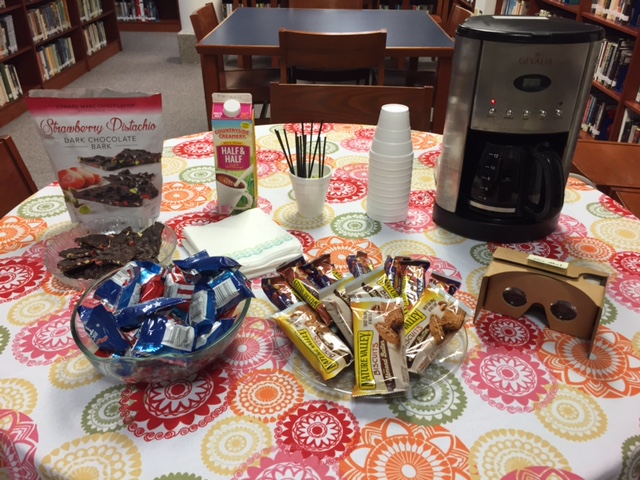
When I came back to school at the end of August, I was excited to share the things that I learned while at the Google headquarters. Through a series of fortunate events, a number of teachers and administrators came to visit the library early on in the year and had the opportunity to test out the Google Cardboard that I received while at Google. It probably helped that I lured them in with chocolate, caffeine, and the promise of a virtual beach vacation (if only for a few moments!). I was fortunate to receive 35 VR viewers through funds received as part of a STEM grant (thank you, Mr. Kotch!), and I was able to put them right to good use.

Through collaboration with several Spanish teachers, I have been taking our students on virtual field trips for a few years; however, our students had never been on a trip like this one before! In an informal poll, I discovered that none of our approximately 120 Spanish III students had ever used a VR viewer before, so this was a pretty unique and exciting experience for them.

We started our trip with what was formerly called the Google Cultural Institute, now labeled Google Arts and Culture. I like students to explore locations curated for their cultural significance. Then, students learned how to use the VR viewers with Google Street View and Google Cardboard apps. They were asked to download these free apps to their smartphones ahead of time, if permitted. Not every student could download the apps, which we had anticipated, so students were able to share or use the few iPhone/iPod devices that we brought with us. And this was the result:


Both the Spanish teacher and I received overwhelmingly positive feedback from students on their experiences with their virtual field trip. In the past, students seemed to learn something from the VFT activity, but we had never received such enthusiasm before use of the VR viewers.

One of my biggest goals as a school librarian is to provide cultural experiences whenever possible. Part of our district's mission statement requires that we grow students into "productive and responsible citizens of an ever-changing global society." I hope that the tiny taste of the world that I can provide for our students might inspire them to explore further in real life.

If you would like to modify my lesson materials for your classes, they are accessible here.


Creative Commons License
Virtual Spanish Trip by Katherine Kauffman Roth is licensed under a Creative Commons Attribution 4.0 International License.


Update: Below is some student feedback from the lesson.

Thursday, December 17, 2015

Highlights from AASL 2015

 Beautiful Columbus, OH! There could not have been a better city to host the conference. I had a lovely dinner in German Village after spending the first day learning at the Idea Lab.

 I met up with another Westmoreland County librarian! I was excited to see so many LMS's from Western PA.

"Beyond Issue" books panel really gave me the opportunity to think about the difference between books about mental illness and books with dynamic characters who happen to experience mental illness. Great book list!

 I attended another fantastic panel that featured "perspectives from the Middle East." The moderator was none other than Sabaa Tahir! So star-struck.

Brian Sleznick's keynote was so fantastic that it prompted me to unexpectedly purchase The Marvels and get it autographed! He is a born storyteller. I put his keynote right up there with the Neil Gaiman lecture I attended in Pittsburgh.

Thursday, October 15, 2015

Library Promotion

As I prepare for my session on collaboration for the AASL 2015 National Conference, I can't help
but reflect on my journey through library promotion. The two facets of school librarianship certainly go hand-in-hand. When I accepted a position as a part-time middle school librarian/part-time high school English teacher back in 2011, I didn't know much about library promotion. In fact, promotion is one of the biggest facets of the job that sets a teacher librarian (with a flexible schedule) apart from a classroom teacher. I knew I needed to make teachers and administrators aware of what the library had to offer them, but I wasn't quite sure how to go about doing that effectively. And I probably didn't do a great job that first year. I had a lot of obstacles to overcome both personally and professionally, but those cannot be excuses for scanty library use. I only really started to become adept at library promotion after I joined the Pennsylvania School Librarians Association Promotions Committee - and I joined quite by accident! I attended my first leadership summit expecting to be a part of another committee that needed more members, but unfortunately the only other member from this committee had other obligations during our meeting time. So, in an effort to make my trip to the workshop worthwhile, I sat down with a lively and organized group of ladies (imagine that - organized librarians!). This group turned out to be the Promotions Committee, and they welcomed me with open arms. Not only did we discuss different ways of effectively promoting our services to our school communities, but we also created a number of advocacy lists to help other librarians discover great ways of promoting their libraries.

One of the greatest professional experiences I have had was presenting a session at the PSLA annual conference. Along with four other amazing school librarians who work with students ranging from grades K-12, we presented ideas for library promotion. While presenting was fun, the best part of doing this presentation was learning from all of the other fantastic librarians who attended the session.  The greatest take-away was that a conference session presenter is merely a facilitator, and using the time to have a group brainstorm can be immensely beneficial to all participants.

Since this presentation, I have now implemented several promotional ideas that I gathered from session participants. One that I have used the past two years is the Used Book Sale. Not only am I able to make a little bit of petty cash for other promotions, but also I am able to provide a reason for parents to check out the library during open house, an incentive for administrators to come see what we are up to in the library, and maybe a way to coax a few students and teachers who do not normally frequent the library to see what we have to offer them. We have received book donations from community members who are happy to give their used books a meaningful home, and we have been able to fund prize drawings and reading incentives for other library promotions.

Based on my previous experiences with library conferences, I cannot wait to facilitate a discussion on collaboration at AASL 2015. I cannot even anticipate the kinds of strategies and project ideas I will gain from my colleagues who have school libraries all over the nation. But I know that I will return from the conference excited to try new ideas and ready to collaborate with teachers.