Showing posts with label secondary library. Show all posts

Thursday, January 19, 2017

Perseverance in the Library

At the beginning of November, I received the call that I have feared every year since I started my school library career: as of that moment, library funding was completely cut. To be fair, all "non-emergency" funding was cut in the entire district. According to the new algorithm for determining federal funding, my district would be receiving significantly less than expected. This "moratorium on spending" of course trickled down to each professional in each building. In some ways, I was fortunate that I got the call in November instead of July because I had already purchased a few staples like our online databases and our reading team books. But I was expecting to spend approximately 70% of the library budget sometime before February, which is our usual yearly spending cutoff date. I took a little bit of time beating myself up for not focusing more on purchasing at the beginning of the school year, but there was no point in brooding over something that I had no control over. Instead, I listed my major goals for the year to determine exactly what I needed in order to continue having a successful year for the library. The first goal was to purchase a list of 50 books that were primarily student recommendations. Contrary to popular opinion, fiction reading in my school library has increased this year, and I am absolutely determined to continue this trend. Secondly, a student last year took the initiative to start a student-run book club during lunches after the reading competition concluded in the Spring. They had selected two books, and we would need at least 25 copies of each. Finally, we need funds to attend our annual field trip to the county reading competition. I needed a plan.

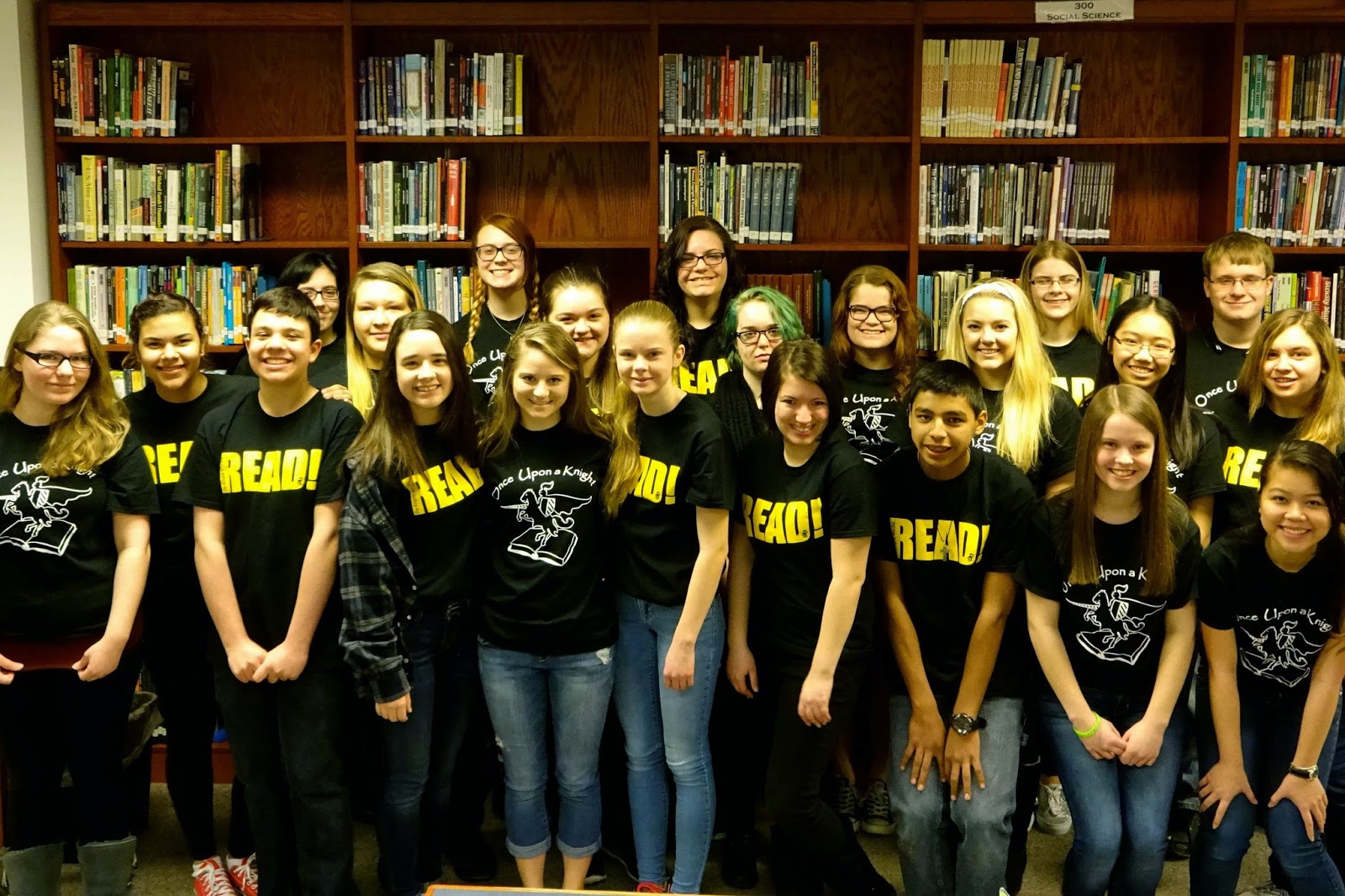
First, I recalled our local Barnes and Noble store contacting me in the past about facilitating an in-store book fair. I contacted them again, and set up a meeting with the manager to discuss all of the details and to set up the date. We chose a date approximately two weeks before Christmas, which proved to be an effective time to have the fair. We advertised in school, on social media, and to parents and community members. We also brought copies of our donation code with us in case people in the store asked us who we were (we were all wearing our school colors or our reading team t-shirts). With a combination of luck and hard work, we earned over $1,600 in books for our library. I am incredibly thankful to Barnes and Noble for helping us to fill our library with new books, and I feel so lucky to work with such wonderful and motivated students. We had students who offered to stay at Barnes and Noble all day to give our donation code to parents and community members who asked for it, although we had such a great volunteer response that we only needed students to stay for 1-2 hour shifts. It was such a great, uplifting day!

Secondly, to ensure that we had enough funds to purchase books for our student-run book club and to possibly go on a field trip, I wrote several grants. For one grant, I was interviewed at the YALSA Symposium in Pittsburgh. My grant proposal was unfortunately not accepted, although the process was a positive one. For this grant, we were required to be able to speak on how individual conference sessions inspired our grant idea and how we might use what we learned in order to improve our home library. Although my grant idea was not selected, I am still hoping to be able to gain funds at some point to make my idea a reality.

Finally, Wal-Mart came through and granted us $750 to run our student book club this year! I am extremely thankful to our local Wal-Mart store for selecting our proposal. I recommend that other school libraries in need consider looking into grants offered by large and small organizations alike. Many companies are happy to support public education, and this librarian is incredibly thankful to them.


Monday, April 11, 2016

Knight Readers - WIRC 2016


Knight Readers Excel at the Westmoreland Interscholastic Reading Competition

Norwin High School students participated in the Westmoreland Interscholastic Reading Competition (WIRC) on February 29, 2016 at Seton Hill University. Two Norwin High School teams, A Midsummer Knight’s Read and Knights of the Round Table, competed against teams from around the region in the grades 9-12 division. In preparation for this annual event, our Knight Readers collectively read fiction and non-fiction texts off of a list of 30 total books. Students discussed these books during lunch meetings and created practice questions to quiz one another on the content of the stories. Students competed against other schools at the event to answer trivia-type questions about the plot and characters of the books they read throughout the year. Both teams faired very well, winning three out of four rounds of competition. A Midsummer Knight’s Read placed 9th this year and Knights of the Round Table placed 5th. This is the first year that both of our teams placed in the top ten and were recognized during the closing ceremony! We are so excited to celebrate the successes of our teams this year. Students in grades 9-12 for the 2016-2017 school year who are interested in joining the Knight Readers should contact Ms. Kauffman in the Norwin High School Library.

Knights of the Round Table
Row 1: Cecilia Koncerak, Rachel Garcia, Sam Naponic (team captain), Natalie Naponic, Yuhan Lu, Hanna Rhoads, Row 2: Hannah Nestlerode, Catherine Balaban, Cole Dempsey, Marina Novotnak, Sebastian Pratt


A Midsummer Knight’s Read
Row 1: Dom Orsino, Anna Swets, Emily Dahlstrom, Kelly Tran, Ashley Divins (team captain), Aimee McGillis, Row 2: Tynan Tinley, Erin Crust, Bella Reiter, Julia Szlis, Madalyn Durmis


Sunday, February 21, 2016

The Library is a Good Place: Small Successes Keep Us Going

"The library is a good place," one of my students said this morning as she sat at the circulation desk and took in her surroundings. I tried to see the space as she saw it in that moment: a group of girls furiously finishing geometry homework tucked away in the fiction section...friends sitting in cushy blue chairs sharing a pair of headphones...a freshman boy flashing an appreciative smile as he takes a Hershey Kiss from the candy dish next to the sign-in sheet. "I cannot believe I didn't know about this place before last year, Ms. Kauffman. It's a good place," she concluded.

She put into words exactly how I want students to view this space: as a positive haven in their busy lives. In the same breath, she also expressed the biggest problem: many students are unaware that the library exists. All students attend a Freshman library orientation, but somewhere in-between their regimented Freshman year and their less-structured years after that, they seem to forget (or worse yet, not realize) what the library can offer them.

This year, we seem to be starting to hit our stride. I would still like to work on promoting the library to those that aren't aware of what it can offer, but we have at least experienced an increase in readership, which is encouraging. I always feel most fulfilled in my career when I get to support our students, especially those unlikely readers. I had a tall, slender senior walk in the other day with a sideways black cap (totally against dress code), saggy jeans, and a plaid flannel shirt. I recognized him as one of the students taking a remedial writing course because he spent a lot of time during class typing (or not typing) his paper in the library. He asked for some read-alike suggestions. I hadn't read the book he mentioned and, based on the cover, had the misconception that it was about overcoming addiction. After doing some research, I discovered that it was really more about coping with mental illness and depression. So, I suggested Ned Vizinni's It's Kind of a Funny Story and Stephen Chbosky's The Perks of Being a Wallflower - both favorites for addressing difficult topics with a touch of humor. He came back the next day specifically to tell me how much he loves Vizinni's story. After having a stressful day when nothing seemed to be going right, his comment made my whole week. This just goes to show that a kind gesture can be the fuel to keep someone doing what they are doing right.

This student taught me a lesson, and I will continue to more often let others know when they have made a difference in my day, my week, my life. Perhaps this is one small way that I can continue to make the library a "good place" for all who use it.

Thursday, December 17, 2015

Highlights from AASL 2015

 Beautiful Columbus, OH! There could not have been a better city to host the conference. I had a lovely dinner in German Village after spending the first day learning at the Idea Lab.

 I met up with another Westmoreland County librarian! I was excited to see so many LMS's from Western PA.

"Beyond Issue" books panel really gave me the opportunity to think about the difference between books about mental illness and books with dynamic characters who happen to experience mental illness. Great book list!

 I attended another fantastic panel that featured "perspectives from the Middle East." The moderator was none other than Sabaa Tahir! So star-struck.

Brian Sleznick's keynote was so fantastic that it prompted me to unexpectedly purchase The Marvels and get it autographed! He is a born storyteller. I put his keynote right up there with the Neil Gaiman lecture I attended in Pittsburgh.

Wednesday, November 25, 2015

The Introverted Public Speaker: Why You Should Still Be a Presenter

I have often pondered the answer to this question: why am I, an introvert, also a public speaker? It doesn't seem to make sense. At the beginning of November, I had the honor of leading a concurrent session at the 2015 AASL national conference. After the thrill of my proposal acceptance wore off, a mild panic set in. I knew I would be prepared, but the racing pulse just wouldn't slow down. Why did I agree to do this?

And then I had to reflect on why I had put so much time into creating a proposal - why I wanted to present so badly. One reason I am a presenter is because I am passionate about what I do. I enjoy being a school librarian, and I am excited to share the projects that have been successful in my library. If my ideas can help a colleague, all the better.

Perhaps the bigger reason I present is because of the librarians who have made me the passionate
professional I am today. Whether I am learning at a conference, in a class, over lunch, from the PSLA listserv, on Twitter, through blogs - I am excited about my job because so many wonderful colleagues have shown me the way. The community of school librarians out there have offered me lesson and promotion ideas, they have modeled how to be a tech leader in their schools, and they have demonstrated how to convey a love of learning. It only seems fair that I pass this excitement on to others. My predecessors should not bear the entire burden of inspiring a whole new class of librarians. We are a community of seekers and most importantly sharers. I present because I feel incredibly lucky to be a member of this community and I want to give back in any way that I can.

Finally, I present because then I get to start the conversation in which I want to participate. I have been very fortunate to attend several different library conferences, and the topic that has most shaped the teacher librarian I am today is library promotion. The only way students get the full impact of their information literacy education is if they have the opportunity to come to the library. I am very lucky to have learned many of my promotion skills at conferences.

If you are on the fence about becoming a conference presenter, put your fears aside and reflect on how much you have gained from other conference presenters. Good luck on your next presentation!

Thursday, October 15, 2015

Library Promotion

As I prepare for my session on collaboration for the AASL 2015 National Conference, I can't help
but reflect on my journey through library promotion. The two facets of school librarianship certainly go hand-in-hand. When I accepted a position as a part-time middle school librarian/part-time high school English teacher back in 2011, I didn't know much about library promotion. In fact, promotion is one of the biggest facets of the job that sets a teacher librarian (with a flexible schedule) apart from a classroom teacher. I knew I needed to make teachers and administrators aware of what the library had to offer them, but I wasn't quite sure how to go about doing that effectively. And I probably didn't do a great job that first year. I had a lot of obstacles to overcome both personally and professionally, but those cannot be excuses for scanty library use. I only really started to become adept at library promotion after I joined the Pennsylvania School Librarians Association Promotions Committee - and I joined quite by accident! I attended my first leadership summit expecting to be a part of another committee that needed more members, but unfortunately the only other member from this committee had other obligations during our meeting time. So, in an effort to make my trip to the workshop worthwhile, I sat down with a lively and organized group of ladies (imagine that - organized librarians!). This group turned out to be the Promotions Committee, and they welcomed me with open arms. Not only did we discuss different ways of effectively promoting our services to our school communities, but we also created a number of advocacy lists to help other librarians discover great ways of promoting their libraries.

One of the greatest professional experiences I have had was presenting a session at the PSLA annual conference. Along with four other amazing school librarians who work with students ranging from grades K-12, we presented ideas for library promotion. While presenting was fun, the best part of doing this presentation was learning from all of the other fantastic librarians who attended the session.  The greatest take-away was that a conference session presenter is merely a facilitator, and using the time to have a group brainstorm can be immensely beneficial to all participants.

Since this presentation, I have now implemented several promotional ideas that I gathered from session participants. One that I have used the past two years is the Used Book Sale. Not only am I able to make a little bit of petty cash for other promotions, but also I am able to provide a reason for parents to check out the library during open house, an incentive for administrators to come see what we are up to in the library, and maybe a way to coax a few students and teachers who do not normally frequent the library to see what we have to offer them. We have received book donations from community members who are happy to give their used books a meaningful home, and we have been able to fund prize drawings and reading incentives for other library promotions.

Based on my previous experiences with library conferences, I cannot wait to facilitate a discussion on collaboration at AASL 2015. I cannot even anticipate the kinds of strategies and project ideas I will gain from my colleagues who have school libraries all over the nation. But I know that I will return from the conference excited to try new ideas and ready to collaborate with teachers.

Sunday, July 5, 2015

PA School Librarian in Germany: Gymnasium


I think that a lot of us were very much looking forward to observing a gymnasium. This school could be compared to an elite secondary school in the States. Serving grades 5-12 (formerly through grade 13), every student and teacher is required to learn English starting at grade 5 (if not earlier), and in the upper grades students must also choose to learn one of the following: French, Spanish, Latin or Italian. All students experience a bilingual education, meaning that they not only learn 2 additional languages, they also have classes taught in English or French. For example, a student might take economics or chemistry, but several days a week they learn the subject in a second language. This is a very authentic way to learn another language, and it appeared to be very effective in creating bilingual students.

The majority of students at the Gymnasium level must attend their local school. This particular school, however, has an excellent gifted program and can accept students from other states just for this specialized program. Grades are determined as 1 (equivalent to approximately an A) through 6 (failing).


In year 10, students receive a 2-week work placement in Germany, England or France. Students here often become so proficient in French that they will take the French exit exam in addition to the Abitur; this ensures that they can seamlessly attend post-secondary education in France, if they desire to do so. The Abitur counts for 1/3 of the graduation score, and the state of Rhineland-Palatinate is the only one of the 16 states to offer un-centralized graduation tests. Teachers create several tests to be sent to the Ministry of Education, the Ministry chooses the test to be administered, and the teacher receives the assessment right before they must administer it to students.


A typical schedule is structured like this: Monday-Thursday classes run 7:55-4:05 and Friday 7:55-12:55. Most lessons are in the morning before lunch, with sports, art and clubs taking place in the afternoon. Most homework is completed during the school day when students have study or tutoring breaks. This school also follows the MINT program, which stands for math, ICT, science and technology, which sounds much like the trend for STEM education in the US. Students also must choose three areas of focus, almost like majors, in order to complete their program of study.

Several of us had the chance to observe a religion class during which a student presented information on Chagall. Mainz is home to a chapel with Chagall glass windows adorning each wall, and so students will visit the chapel next week to see the work in person. Students analyzed the work projected onto a screen using the stylistic and biographical information provided by the presenter. At the end of the presentation, the teacher asked students to offer an evaluation of the presenter, and students very professionally offered both praise and criticism.


The students we spoke with were very impressive. It was clear that these students were very bright and had experienced an excellent education. Their English proficiency was impeccable, and each of them had spent a significant amount of time in the US. All three of them were serious students, but with different majors of study and interests outside of school. All of them plan to attend Universitat after Gymnasium, although only one of them seemed to know where she would like to attend after school.


This school was also the first public school we visited that offered a traditional school library for students. The book cataloging and management of the library is performed by parent volunteers. The mother running the desk during my visit very kindly answered all of my questions about school libraries in Rhineland-Palatinate. She had been helping with the school libraries since her children were young (their primary school had a library, as well). Libraries are traditionally run by mothers in two-hour shifts. This one had 11 computers for students to use in order to create projects or type papers. There were volumes of popular fiction and materials for research. The mother running the library confirmed what student had mentioned to me; teens seem to prefer to buy their books rather than borrow them from the school library. I do not know if this is typical of German teens in general, or just of the teens in the schools we visited.

Overall, it was a fantastic visit, and I especially enjoyed speaking with the panel of German students.

Wednesday, May 20, 2015

Student Volunteers


Student volunteers are essential to the daily operations of our high school library. As I finish my third year as a full-time librarian, I have a much better grasp on "hiring," training, and working with volunteers. My goals are to have happy volunteers who love the library, while maintaining a productive library and positive learning environment.

Hiring
My hiring practices have changes over the past few years. I instituted an application/mini-interview process along with some advertising. I find that only students who are very interested in the position take the time to apply, and during the interview I have the chance to convey my high expectations for student volunteers. I provide an overview of possible tasks, which gives students the chance to determine if they are willing to put forth the necessary effort. In terms of advertising, I give applications to club advisers whose students may need volunteer hours. I also advertise on the morning announcements during the first week of a new semester.

Training
After being hired, I ask volunteers to read through a volunteer handbook I created. The handbook provides a list of period-specific tasks (certain things have to happen in the morning, some in the afternoon), instructions on shelving, shelf reading, dusting, due date cards, study hall passes, sign in sheets, technology use, obligations letters, processing discarded books, etc. I also have screen shots for properly checking books in and out using Destiny Library Manager. This student handbook can also be helpful for substitute librarians! After reading the handbook, I train students in person during their lunch periods. I find that my sanity prefers to only do two trainings, as opposed to nine or ten. I provide a light lunch as a thank you to volunteers for offering their services and also as a thank you for coming to training during their lunch period. It's a nice time for students to see who else is volunteering, and the afternoon aides get to meet the library secretary who is only in the library during the mornings.

Working
I try to have some sort of a routine for students, even if each day has different tasks. Study hall library aides count and run passes first thing, and then they can check for additional notes on the front desk. I also verbally instruct students on what to do for the class period, so that they know my expectations. I try to provide choices as often as possible. Inevitably, I learn my students' strengths and utilize these as best I can. Often big readers want to work in the library, and I will periodically ask for ordering suggestions (after all, the books I order are for them!). If I have a display idea, I'll ask students to help pull their favorite books that fit the theme. I also find that some of my more outgoing readers are excellent at Readers Advisory. I notice that volunteers will watch me ask students RA questions, and then they are able to model their own RA process after mine. When I have artists, I'll have them make signs and posters for the library. Some of my students even instituted an internship program, where they started training younger students to take over the library the following year. These moments of leadership always make me feel so proud and thankful for my kids!

Appreciation
Finally, I try to show my appreciation for my volunteers as often as I can. When we finish a big job, I like to get doughnuts or cookies. I give gifts to students before Winter break and play movies for them in the library. I purchase senior gifts and small underclassmen gifts at the end of the school year. But your appreciation does not have to cost money. You could allow students to choose a book to be purchased for the library and let them check it out first. You could dedicate a book to each volunteer and place a dedication plate in the front of each book. You could let them pick a day to have a potluck in the library during lunch.

I cannot put a price on the mutual benefit of student volunteers. I gain hundreds of man hours, which frees up some of my time to tutor students, promote the library, collaborate with teachers, or lesson plan. Volunteers gain work experience, a resume-builder, a built-in reference, and necessary volunteer hours for clubs. If you are not already using student volunteers, please consider this valuable experience for you and your students!

Monday, April 20, 2015

But Wait...There's More!

I try to do a book series display for students every year. I find that a lot of teenagers enjoy getting lost in a series. Often, they will read a book from a series in a night or two and be excited to come and get the next one ASAP. I found a concept on Pinterest for this type of display, using the infomercial quote "But wait, there's more!" So, I found a picture of a well-known infomercial actor and pasted book covers in his hands to make it look as though he's selling books. The display has been effective so far: I've gotten some chuckles from students, and a number of books have been checked out from the display. Score for Pinterest and Ms. Kauffman!

Thursday, April 16, 2015

National Library Week - Free Fine Deletion and Teacher Recommendations

Photo Credit: Wilson Hutton from Penn State News
It's National Library Week! And this week I find it to be important to recognize everyone that makes the library possible. In the past, I've gotten cookie cakes for my library aides in honor of National Library Worker's Day, and this year we did Dunkin Donuts.

For patrons, I offer free fine deletion every year during National Library Week. I know that fines are sort of a hot button issue in school libraries - some librarians find them to be exclusionary and unfriendly. Personally, I like to think of library fines as preparation for late fees that students might encounter in their adult lives. Whether fines are for late library books, the electric bill, credit card bills, or something else, I think that knowing that there is some sort of consequence is realistic. This is not to say that everyone doesn't deserve a break now and again! We tend to get a lot of books back during National Library Week, which helps students out, but also is beneficial for the library and the main office. We called parents about missing materials the week before NLW, and we were happy to be able to tell them that fines would be waved if materials were returned the following week. I find that having a week of free fine deletion is good PR, but I do not find that charging fines in the first place is particularly bad PR for the library.

I also asked teachers to write book recommendations to be included on the summer reading Doc posted to the library page. Last year, I displayed recommendations in the library, but I thought it would be more beneficial for students to be able to access the recommendations online instead. So, thus our summer read list was born. I am always excited to see what teachers are reading and what they loved enough to recommend to students. I enter all teacher participants into a drawing for a small gift card, just as a token of my appreciation. I hope everyone with a connection to a library had a fantastic National Library Week!

Monday, March 16, 2015

Knight Readers Book-It to the Top of Westmoreland Interscholastic Reading Competition


*The following article was written by K. Kaufman and will appear in the Knight Vision newsletter

Norwin High School students participated in the Westmoreland Interscholastic Reading Competition (WIRC) on March 9, 2015 at Seton Hill University. Along with the two Norwin High School teams, Once Upon a Knight and The Knights Who Say Read!, forty other teams from around the state competed this year in the grades 9-12 division. In preparation for this annual event, our Knight Readers collectively read fiction and non-fiction texts off of a list of 30 total books. Students discussed these books during WIRC meetings and created practice questions to quiz one another on the content of the stories. Students competed against other schools at the event to answer trivia-type questions about the plot and characters of the books they read throughout the year. We are very proud of both of our teams! The Knights Who Say Read! won one round of competition, and Once Upon a Knight won four rounds of competition, placing them sixth amongst the forty-two total teams! We are so excited to celebrate the successes of our teams this year. Students in grades 9-12 for the 2015-2016 school year who are interested in joining the Knight Readers should contact Ms. Kauffman in the Norwin High School Library.

Friday, February 20, 2015

Girl's Mentoring Event

We have some pretty fantastic kids at school - kids who not only work hard, but also students who look out for one another. A group of incredible senior girls decided to start a girl's mentoring program called the Knights in Shining Armor. This organization brings together friendly, motivated, successful senior and freshman girls who want to get involved in their school. Together, they do a variety of activities: yoga, crafts, book clubs, etc., lead by different teachers throughout the school. During these activities, the freshmen can ask for advice from their older, wiser peers, or just network with one another and make new friends.
"Knitted Heart." by mararie is licensed under CC BY 2.0

Just before Valentine's Day, I offered to facilitate a craft afternoon where students could make cards or little candy boxes. I provided hot chocolate with heart marshmallows, and the girls brought brownies and popcorn to snack on during the craft hour. Listening to these smart, funny, strong, and friendly girls work together and offer their expertise on all things school made my heart happy. I didn't know many of the girls before the event, but I left with a smile on my face that there are such wonderful things going on at our school - events that are entirely student organized and student driven. These girls recognized a need for a mentoring group that could lead their younger peers on the right path to success, so they made one. And I know I am not alone in my pride for these lovely young women, as a number of teachers wanted to know what they could do to contribute to such a fantastic organization. I think I certainly learned an important lesson from them: do not wait for good things to happen, make them happen!

Saturday, February 14, 2015

Evaluating Resources

According to the PA Core Standards, students must be able to evaluate resources based on credibility, relevance, currency, accuracy and bias. Many students understand that they need to use "good" resources, but find it much more difficult to define exactly what this means. In order to help my students to determine if a resource is worthwhile for a particular project, I devised a rubric for evaluation. Teachers use rubrics in order to make subjective evaluations more concrete, so it only makes sense to teach students to do the same thing in their evaluation of resources. I urge students to recognize that the same source might receive excellent scores for one research topic, but only mediocre scores for another. The research question or thesis statement greatly influences which resources are most useful. I try to make this concept easy to conceive for students with a number of examples throughout the evaluation rubric. The best part of having a very structured form for evaluation is that it only takes a few minutes to go over, and then students have a reference point for the rest of their research endeavors. After using the rubric for several projects, students no longer need to use the physical rubric because they begin to look for elements of good resources automatically.


Please feel free to modify and use the Evaluation of Resources rubric with your students. If you repost this rubric, please provide proper credit!

Tuesday, December 23, 2014

Maker Week Completed!

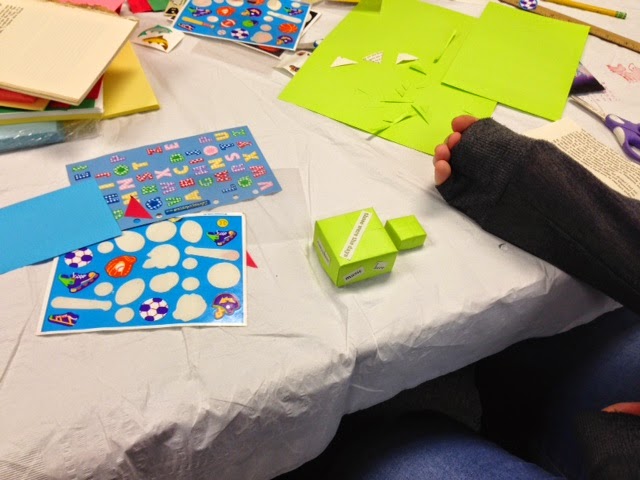
Although Maker Week got off to a slow start, the concept was successful overall. The most popular maker items were book page ornaments and paper boxes filled with Hershey Kisses. Initially, the promise of chocolate seemed to bring a number of students to the library; however, once the students started to make the boxes, they seemed to genuinely enjoy creating something. Several students even came down the next day requesting to make more boxes (which was fabulous, of course!). Eventually, students started to get creative and made up their own projects - mostly small gifts for friends. This was certainly encouraging and seemed to be in the same spirit as maker spaces.

I think that if we do a something similar in the future we will have Maker Days, as opposed to Maker Week. I was glad to do the whole week my first go around, just because I wasn't sure which projects or materials would be most popular. Now that I have a better idea of what students want to make and what will bring them into the library, I am confident that I could condense the concept into just a couple of days.

I also had to experiment with promotion methods. I had display of maker items outside of the library, there were announcements broadcast over our student news program, I had a blurb added to our daily bulletin, and I sent emails to our study hall teachers. Emailing study hall teachers so that they could remind students of Maker Week and send them to the library seemed to be the most successful promotion. Ultimately, my goal was met: I got students into the library. Many of my maker kids were not our usual customers, so it was great to see some new faces. I also was excited to see some of our new patrons stop in again after their first visit - some students came down for multiple maker days, or they came to the library for study hall or to find books in-between classes. Library promotion might take some work, but it is totally worth it!
Completed paper boxes

Thursday, December 4, 2014

Maker Week

We are trying something new in our high school library this year. The week before Winter Break, we will hold our first ever Maker Week. Each day, different materials will be available for students to upcycle into holiday gifts for friends or family members. Students will be able to use materials such as discarded books, magazines, card stock, laminate sheets, stickers and more. I am trying to purchase very little to support Maker Week; I would prefer that students use their creativity to make something interesting out of existing materials. They will be encouraged to create unique items; however, there will be samples available in case they need some inspiration. The examples I created ahead of time include a magazine tree, book page ornaments, a small paper box filled with candy, bookmarks and holiday cards. The library secretary created a lovely display outside of the library several weeks before the start of Maker Week in order to foster student interest ahead of time. I also requested an announcement to be read over the student news program, and I provided an ad to be included in the daily bulletin. I am excited about Maker Week, and I am anxious to see what the students create! I'm sure I will post during or after Maker Week to include what I learned throughout the process.

Friday, November 21, 2014

Happy Movember!

In celebration of Movember, a movement in which men grow mustaches to draw awareness to men's health issues, I decided to do a fun book display. This originally was a Pinterest find several years ago, but I had never found the right moment to put it together. Movember seemed like a perfect excuse to put mustaches on everything! My favorite cover is the one of Marley with a mustache.