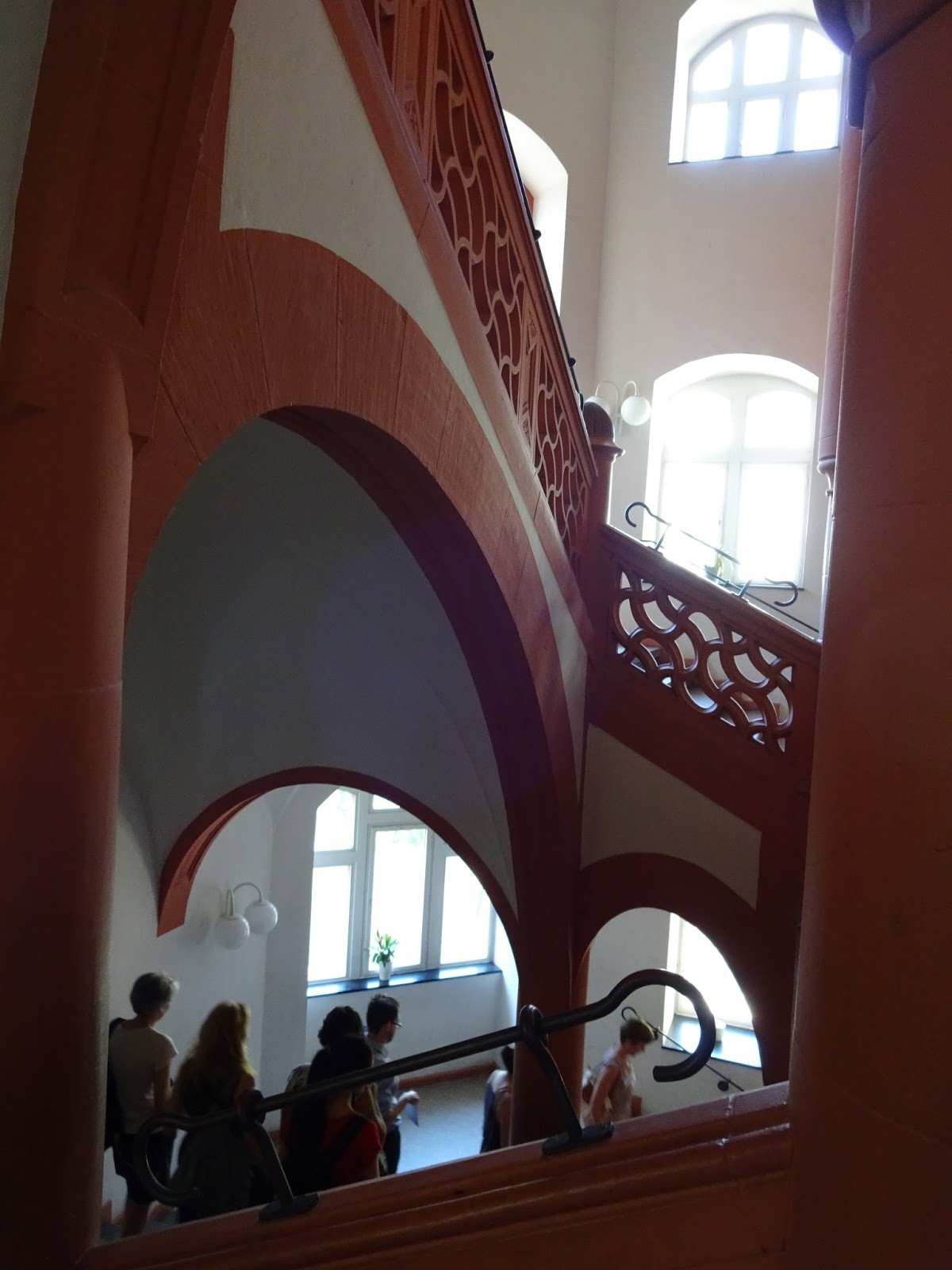
On Monday we visited a private all girl's Catholic school. The school was founded 250 years ago, and at one time was run by nuns. This school offers both a gymnasium and a vo-tech education.
Although the school is a private school, they still receive funding from the state, and therefore is free for students to attend. Students do not have to be Catholic, or even Christian, to attend the school; however, they must have a very moral foundation. Likewise, teachers do not have to practice a particular religion, but they seem to be held to a high moral standard (not unlike teachers in the US). The school is founded on the ideas of respect, help, solidarity and a commitment to making the world a better place. In the 11th-grade, students must complete a 4-week internship at a social institution. Many students intern at hospitals or kindergartens in order to fulfill this work requirement.
God, of course, is important at this Catholic school. Students must periodically attend services at school, but these services do not occur weekly. Students do not necessarily attend church with their families every weekend, and membership in a church is not compulsory.
The sciences are a big focus of the school, and because of this focus, girls tend to perform well on their science exams. Music is also a big focus, and the school boasts two orchestras: one for the younger grades and one for the older. Students have the opportunity to perform at the beautiful concert hall in Mainz.
Many exchanges are offered with foreign schools, and students are required to learn English or French as the first foreign language, and Latin or Spanish as the second foreign language. Eighty percent of girls attending the gymnasium end up also attending university.
At the vo-tech program, girls have the chance to study economy and administration or home economics and nutrition. Students receive the Realschule certification from this program, and the school does accept students from other schools for just the two year vo-tech program. After the vo-tech program is over, students can continue attending a specialist school in their field, or else they can choose to continue school and receive their Abitur.
We had the chance to speak with some fantastic English teachers who very generously gave of their time. The woman I spoke with had actually attended the school as a girl and then quite by coincidence was assigned to teach at this school by the state. She mentioned that she is thankful for this placement, and I must say that the teachers at the school all seemed very positive and they seemed to like their school and their colleagues very much. What a wonderful place for girls to be educated!
Showing posts with label Fulbright. Show all posts
Wednesday, July 8, 2015
PA School Librarian in Germany: Cultural Experiences
On Saturday of the Fulbright program in Germany, we had the day off. By "day off" I mean that we had an opportunity to create our own cultural experience. I chose to visit Heidelberg, which is only 50 minutes away from Mainz by IC train. I think pictures will do the trip better justice than any words could ever do!
In the evening, one of our group members organized a beautiful trip to Bingen, which is about a 30 minute train ride from Mainz. Bingen and the surrounding towns were having a summer celebration. Each town provided a fireworks display, and boats would follow the fireworks on the river. It was quite a sight!
Sunday, July 5, 2015
PA School Librarian in Germany: Gymnasium
I think that a lot of us were very much looking forward to observing a gymnasium. This school could be compared to an elite secondary school in the States. Serving grades 5-12 (formerly through grade 13), every student and teacher is required to learn English starting at grade 5 (if not earlier), and in the upper grades students must also choose to learn one of the following: French, Spanish, Latin or Italian. All students experience a bilingual education, meaning that they not only learn 2 additional languages, they also have classes taught in English or French. For example, a student might take economics or chemistry, but several days a week they learn the subject in a second language. This is a very authentic way to learn another language, and it appeared to be very effective in creating bilingual students.
The majority of students at the Gymnasium level must attend their local school. This particular school, however, has an excellent gifted program and can accept students from other states just for this specialized program. Grades are determined as 1 (equivalent to approximately an A) through 6 (failing).
In year 10, students receive a 2-week work placement in Germany, England or France. Students here often become so proficient in French that they will take the French exit exam in addition to the Abitur; this ensures that they can seamlessly attend post-secondary education in France, if they desire to do so. The Abitur counts for 1/3 of the graduation score, and the state of Rhineland-Palatinate is the only one of the 16 states to offer un-centralized graduation tests. Teachers create several tests to be sent to the Ministry of Education, the Ministry chooses the test to be administered, and the teacher receives the assessment right before they must administer it to students.
A typical schedule is structured like this: Monday-Thursday classes run 7:55-4:05 and Friday 7:55-12:55. Most lessons are in the morning before lunch, with sports, art and clubs taking place in the afternoon. Most homework is completed during the school day when students have study or tutoring breaks. This school also follows the MINT program, which stands for math, ICT, science and technology, which sounds much like the trend for STEM education in the US. Students also must choose three areas of focus, almost like majors, in order to complete their program of study.
Several of us had the chance to observe a religion class during which a student presented information on Chagall. Mainz is home to a chapel with Chagall glass windows adorning each wall, and so students will visit the chapel next week to see the work in person. Students analyzed the work projected onto a screen using the stylistic and biographical information provided by the presenter. At the end of the presentation, the teacher asked students to offer an evaluation of the presenter, and students very professionally offered both praise and criticism.
The students we spoke with were very impressive. It was clear that these students were very bright and had experienced an excellent education. Their English proficiency was impeccable, and each of them had spent a significant amount of time in the US. All three of them were serious students, but with different majors of study and interests outside of school. All of them plan to attend Universitat after Gymnasium, although only one of them seemed to know where she would like to attend after school.
This school was also the first public school we visited that offered a traditional school library for students. The book cataloging and management of the library is performed by parent volunteers. The mother running the desk during my visit very kindly answered all of my questions about school libraries in Rhineland-Palatinate. She had been helping with the school libraries since her children were young (their primary school had a library, as well). Libraries are traditionally run by mothers in two-hour shifts. This one had 11 computers for students to use in order to create projects or type papers. There were volumes of popular fiction and materials for research. The mother running the library confirmed what student had mentioned to me; teens seem to prefer to buy their books rather than borrow them from the school library. I do not know if this is typical of German teens in general, or just of the teens in the schools we visited.
Overall, it was a fantastic visit, and I especially enjoyed speaking with the panel of German students.
PA School Librarian in Germany: Technical Schools
The candid conversations we experienced here with both staff and students has been unparalleled thus far. The school was very welcoming and had clearly made a lot of preparations in order to make our visit interesting, informative, and enjoyable. Of course our favorite part of the program was the homemade meal that was prepared, in part, by students at the school. The creamy cucumber soup was one of the best things I have tasted in Germany! And the homemade ice cream, prepared with raspberries from the chef's garden, was just "fantastisch!" Not even pictures will do this meal justice, but here they are anyway!Thursday, July 2, 2015
PA School Librarian in Germany: Realschule
"Hello, USA!" a student enthusiastically greets me as I entered a local realschule plus here in Mainz. This school is comprised of two buildings: one for grads 5-6 and another for grades 7-10. Much like the grundschule we visited the day before, this middle-level school is comprised of a large immigrant population. The school houses 850 students, many from Turkey and Africa, along with 80-90 teachers. For all students at this level, learning English is compulsory. This particular school has been bestowed the honor of being considered a Europaschule, which translates to "European School." According to Wikipedia (I know it is a librarian sin to use Wikipedia, but it had the best translation!), a Europaschule must follow several criteria: "1. Integration of European issues, 2. Language Learning, 3. Project-oriented school partnerships and internships, 4. Personnel training and development, 5. European School in the Region, 6. Quality Assurance" ("Transnational Criteria"). As part of these criteria, students have an option to receive a three-week work experience in England.

At this school, a head teacher or principal along with his deputy gave us an understanding of how their school works, but also how secondary education in general is run in the state of Rhineland-Palatinate. In Germany as a whole, the head of the school (what we would call a principal), must also teach classes - minimum four per week. Teachers and students must attend school for 192 days a year, and teachers receive six days of leave for self-chosen, compulsory trainings. Periodically, principals may need to ask teachers to complete paperwork over student breaks, but teachers are guaranteed at least 30 days of leave time.
Included in the school's mission statement are three basic rules: punctuality, respect, and order. I observed these rules in the English classroom I had the pleasure of observing. The deputy principal invited half of our American group into his classroom, while the other half observed another English class. The teacher very kindly incorporated us into his lesson. We each introduced ourselves, along with our state of origin, and the students answered some questions in English about America. Then, we were asked to wander around the classroom and help students to complete a summary of a Mark Twain story they read for class. We were thankful to have the opportunity to work with students, and we were also grateful for the lovely lunch the school provided for us!
"Transnational Criteria." Bundez-Netzwerk Europaschule. 2015. Web. 2 July 2015. <http://translate.google.de/translate?hl=en&sl=de&u=https://de.wikipedia.org/wiki/Europaschule&prev=search>.

At this school, a head teacher or principal along with his deputy gave us an understanding of how their school works, but also how secondary education in general is run in the state of Rhineland-Palatinate. In Germany as a whole, the head of the school (what we would call a principal), must also teach classes - minimum four per week. Teachers and students must attend school for 192 days a year, and teachers receive six days of leave for self-chosen, compulsory trainings. Periodically, principals may need to ask teachers to complete paperwork over student breaks, but teachers are guaranteed at least 30 days of leave time.
Included in the school's mission statement are three basic rules: punctuality, respect, and order. I observed these rules in the English classroom I had the pleasure of observing. The deputy principal invited half of our American group into his classroom, while the other half observed another English class. The teacher very kindly incorporated us into his lesson. We each introduced ourselves, along with our state of origin, and the students answered some questions in English about America. Then, we were asked to wander around the classroom and help students to complete a summary of a Mark Twain story they read for class. We were thankful to have the opportunity to work with students, and we were also grateful for the lovely lunch the school provided for us!
"Transnational Criteria." Bundez-Netzwerk Europaschule. 2015. Web. 2 July 2015. <http://translate.google.de/translate?hl=en&sl=de&u=https://de.wikipedia.org/wiki/Europaschule&prev=search>.
Wednesday, July 1, 2015
PA School Librarian in Germany: Grundschule
Our hosts kindly allowed us to observe some lessons. First, I sat in on a lesson for properly telling time, and then I watched a music lesson during which the students identified different instruments. I especially enjoyed hearing students introduce themselves and where they were from because so many had traveled from the Middle East and Africa. I had not considered before my arrival here in Mainz just how many immigrant students would be a part of the German education system. And for these children, German is their second language, and English would be their third! It is not terribly uncommon for children in this area to learn 4 languages before leaving school.
Compared to the US, we noticed a distinct lack of technology in the classrooms, something that also surprised me. The directer of the school told us that to them, basic education and learning the social constructs of school are much more important than technology at the elementary level. For so many of these students, just speaking and learning in German all day can be a struggle.
Several very impressive students made a huge effort to seek out our group and make us feel at home by speaking with us using an astonishing level of English fluency. This very first visit has already opened my eyes to the diversity present in the German education system. With this diversity brings both challenges and strengths that I am excited to explore further.
Tuesday, June 30, 2015
PA School Librarian in Germany: German Education System
We have arrived in Mainz! This morning, we attended two lectures at the university: "The Beginnings of a Bridge to the New World. The University of Mainz, the state of Rhineland-Palatinate and French post-war policies" presented by Dr. Kissener of the History Department and "Educational Policy as a Welfare State Key Instrument. The Functional Transformation of Educational Policy in Rhineland -Palatinate," given by Dr. Mielke of the Department of Political Science. Both of these lectures gave us the background necessary to engage in conversation about the state of German education today.
American and German school systems follow very different structures. German students attend kindergarten and then Grundschule, which is for grades 1-4. Then, with the recommendations of teachers and ultimately parents, students choose from three different tracks for their grades 5-9+ education. It is important to note that education is run by each individual state in Germany, so some information might be specific to Rhineland-Palatinate. Hauptschule offers vocation-oriented schooling and is for grades 5-9. At the end of the 9th grade, students receive their certificate of completion. This Hauptschule track does not exist in Rhineland-Palatinate, but has been incorporated into the next track and into the comprehensive school. Realschule (or Realschule Plus in RLP) is for grades 5-10, and leads to higher education in vocational schools ("German School System"). Finally, the Gymnasium is for grades 5-13 (some to grade 12) and leads to the Abitur certificate. Graduates with the Abitur continue on to Universität. German education costs nothing for students, and a Gymnasium graduate is guaranteed a spot to study at a German university. A newer school system called the Gesamtschule offers a comprehensive system where students can receive the equivalent certificate of any of the three tracks.
Just as with accelerated tracks in the American school system, it is difficult for German students of a lower socio-economic status and immigrant children to break into the Gymnasium learning track.
But German education is changing. Schools once followed a half-day schedule, and now more and more are offering full day education. There is also a push for more students of all backgrounds to work toward the Abitur. These goals are difficult to accomplish amongst the 16 German states, which govern the 16 separate school systems.
Ultimately, my colleagues and I have started to recognize that despite (or in spite of) the differences between American and German education, there seem to be similar goals and obstacles. Both countries seem to desire for their students to achieve unified standards and objectives, but with this standardization of education, individuality (of both students and teachers) is sacrificed. I hope that throughout the next few days, we can start to focus on some small moments of positive change that can be implemented throughout future education practices in both the US and Germany.
American and German school systems follow very different structures. German students attend kindergarten and then Grundschule, which is for grades 1-4. Then, with the recommendations of teachers and ultimately parents, students choose from three different tracks for their grades 5-9+ education. It is important to note that education is run by each individual state in Germany, so some information might be specific to Rhineland-Palatinate. Hauptschule offers vocation-oriented schooling and is for grades 5-9. At the end of the 9th grade, students receive their certificate of completion. This Hauptschule track does not exist in Rhineland-Palatinate, but has been incorporated into the next track and into the comprehensive school. Realschule (or Realschule Plus in RLP) is for grades 5-10, and leads to higher education in vocational schools ("German School System"). Finally, the Gymnasium is for grades 5-13 (some to grade 12) and leads to the Abitur certificate. Graduates with the Abitur continue on to Universität. German education costs nothing for students, and a Gymnasium graduate is guaranteed a spot to study at a German university. A newer school system called the Gesamtschule offers a comprehensive system where students can receive the equivalent certificate of any of the three tracks.
Just as with accelerated tracks in the American school system, it is difficult for German students of a lower socio-economic status and immigrant children to break into the Gymnasium learning track.
But German education is changing. Schools once followed a half-day schedule, and now more and more are offering full day education. There is also a push for more students of all backgrounds to work toward the Abitur. These goals are difficult to accomplish amongst the 16 German states, which govern the 16 separate school systems.
Ultimately, my colleagues and I have started to recognize that despite (or in spite of) the differences between American and German education, there seem to be similar goals and obstacles. Both countries seem to desire for their students to achieve unified standards and objectives, but with this standardization of education, individuality (of both students and teachers) is sacrificed. I hope that throughout the next few days, we can start to focus on some small moments of positive change that can be implemented throughout future education practices in both the US and Germany.
| "Bildungssystem in Deutschland." Wikipedia.de. 2015. Web. 29 June 2015. |
"German School System." How to Germany. 2015. Web. 29 June 2015. <http://www.howtogermany.com/pages/germanschools.html>.
Sunday, June 28, 2015
PA School Librarian in Germany
| Photo taken from Mt. Washington |
I am currently
in the air, having just left Pittsburgh International Airport bound for Mainz,
Germany*! I have been anxiously anticipating this moment since February, after
learning that I was accepted by the German American Fulbright Commission to
attend a seminar for high school teachers. For
the next two weeks, I will
participate in a program entitled “Education
in Germany - a Multi-Faceted System,” along with 14 other American teachers.
Although the program schedule is very full, I find it important to document my
experiences here, whenever I have a free moment. I hope to be able to look back on these two weeks and continue to learn from them, long after the program is over.
| Mainz-bound! |
“As a school librarian,” I state in my
seminar application, “I convey my curiosity
and passion for learning through the way I approach my profession and through
the way I live my life. This passion for learning continually manifests itself
as a desire to be culturally literate for my students, for my peers, and for
myself.” I feel incredibly lucky to have the opportunity to learn about the
German education system from the teachers at German schools and through the
faculty at Johannes Gutenberg University, Mainz. I will be forever grateful to
these teachers (and to the German American Fulbright Commission!) for helping me to gain a greater sense of cultural literacy. In turn,
I hope to be a good ambassador for my school, the library profession, and my
country.
*I wrote this entry in the air, but had to post it when I had access to wifi. So, (update) I have arrived!
** For those interested in joining a similar program (either as a professional in the US traveling to Germany or as a professional in Germany traveling to the US), see the German American Fulbright Commission website.
| On the Main River in Frankfurt |
Subscribe to:
Posts (Atom)